
Gods & companions
Rind
Vali’s mother in the story of vengeance
Rind is named as the mother of Vali, Odin’s son associated with vengeance for Baldr. The Eddic prose notices are brief.
Explore the stories ↓
A place in the divine genealogy
Gylfaginning names Rind when it introduces Vali and later includes her among the goddesses alongside Jord. These statements identify an important relationship but do not narrate her courtship, life or personal response to the vengeance carried out by her son.
Do not substitute a different tradition silently
Other medieval works tell more elaborate and troubling stories involving a similarly named figure and Odin. Those need to be introduced with their own sources rather than inserted unnoticed into Snorri’s short notices. For this Eddic profile, the secure starting point is the named relationship: Rind is Vali’s mother. A longer reconstruction would require a separate comparison of traditions.
Named in a prophecy of vengeance
In Baldrs draumar, Odin compels a dead seeress to tell him who will avenge Baldr. Her answer names Rind as Vali’s mother in Vestrsalir. The child will act when only one night old and will not wash his hands or comb his hair before carrying out the vengeance. The prophecy makes Rind necessary to the future sequence, but it does not describe the circumstances of conception or allow her a speaking part. Those omissions should not be filled by silently importing another author’s story.
Saxo gives Rinda a different and violent story
Saxo’s Gesta Danorum recounts Odin approaching Rinda under several disguises. She repeatedly rejects him; he eventually exploits a supposed medical treatment to rape her. Their son, called Boe in Elton’s translation, later kills Hother and dies of his wounds. This is not the same narrative as the Eddic one-night-old avenger. The related names invite comparison, but Saxo’s Christian, humanising treatment and his distinct plot must remain visible. Rinda’s refusals should be stated plainly rather than softened into a successful courtship.
Read behind the retelling
Sources & limits
The brief Eddic notices do not supply the elaborate courtship narratives found elsewhere. Different traditions require separate attribution.
- Gylfaginning, chapters 30 and 36
- Baldrs draumar, stanza 11; Bellows translation
- Saxo Grammaticus, Gesta Danorum, Book III; Oliver Elton translation
Retold in contemporary English. Dialogue is summarized, not presented as a translation. How to read our sources and versions.
Follow the thread
Stories & related reading: Rind

2 min read
The death of Baldr
Frigg tries to protect Baldr from every danger, but Loki finds the one promise she did not obtain.
Read the story ↗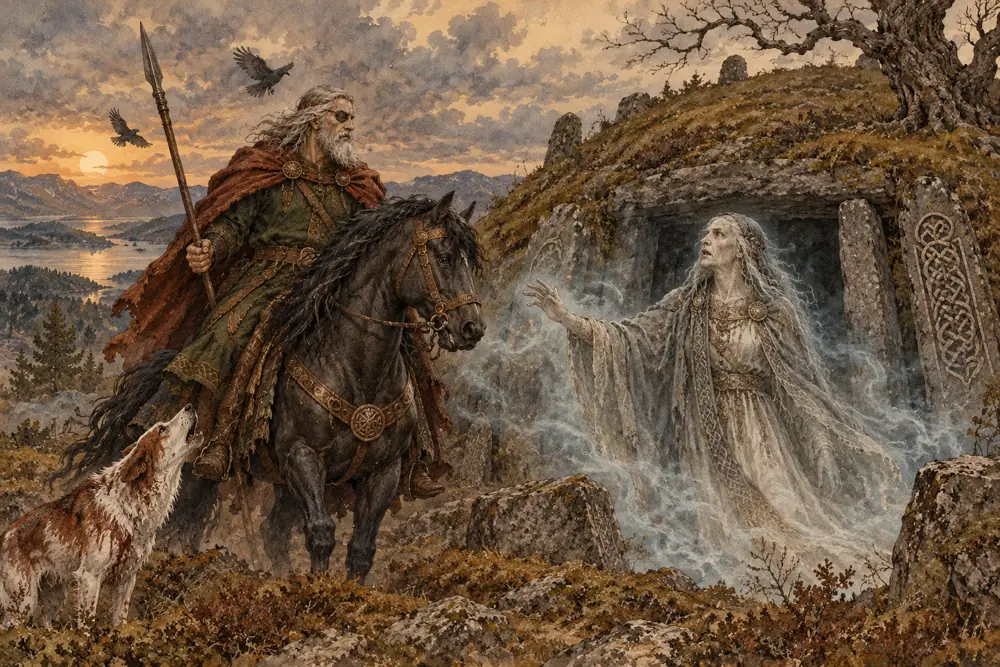
2 min read
Baldr’s dreams and the awakened seer
A disturbing dream sends Odin beneath the world, where preparations for a guest reveal the danger facing his son.
Read the story ↗
2 min read
Odin and Rinda in Saxo
Saxo’s disturbing narrative makes the birth of Balder’s avenger the result of deception and sexual violence.
Read the story ↗