
A Norse story · 2 min read
Loki and the otter’s ransom
The gold that carries a family’s ruin
An apparently easy catch traps three gods in a deadly compensation claim and sets a heroic legend in motion.
A boast at the waterfall
Odin, Hoenir and Loki travel together and come upon an otter eating a salmon beside a waterfall. Loki kills it with a stone and boasts that one throw has secured both animals. The travellers later ask for hospitality at Hreidmar’s house and show their catch. What looked like food is a member of their host’s family: the otter was his son Otr in animal form. Hreidmar and his other sons seize the gods.
The required payment
To regain their freedom, the gods agree to compensation. They must fill the otter skin with gold and cover its outside so completely that no part remains visible. Loki seeks the wealth of the dwarf Andvari, who is found in fish form. In Skáldskaparmál Loki catches him and demands his treasure; Reginsmál’s framing prose provides a related version involving a net. The telling should identify its source rather than quietly borrowing every detail from both.
The ring that cannot be kept
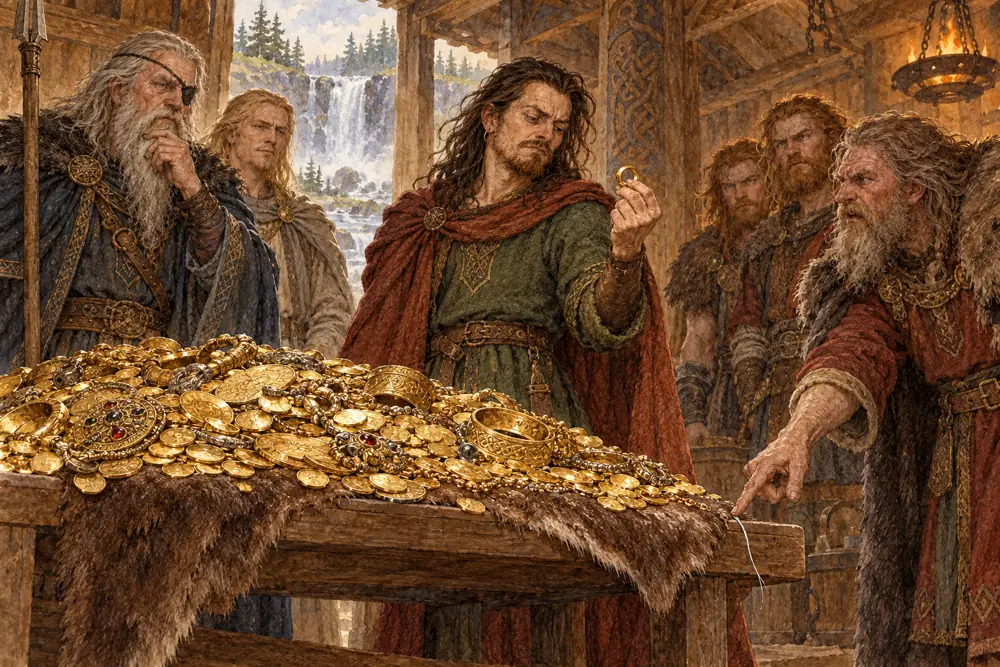
Andvari tries to retain one ring, but Loki takes it as well. The dwarf lays a curse upon the treasure. Back at Hreidmar’s house, Odin admires the ring and holds it aside while the skin is covered. One hair remains exposed. Hreidmar insists that the agreement be fulfilled exactly, so Odin surrenders the ring to cover the last gap. Only when the gods are free does Loki announce the curse that accompanies the payment.
From gods to dragon-slayer
The gold does not heal the household’s loss. Its possession produces further violence, and the narrative moves toward Fafnir guarding the hoard in serpent form and Regin drawing Sigurd into its story. The episode therefore stands at the boundary between divine mythology and heroic legend. It also explains poetic expressions for gold connected with compensation and conflict. The irony begins with Loki’s first boast: a seemingly effortless gain becomes an obligation no one can discharge without handing danger to somebody else. The gods escape the household, but the story of their payment has only begun.
Read behind the retelling
Sources & limits
This retelling principally follows Skáldskaparmál. The heroic legend has variant prose and poetic witnesses; Andvari’s ring is not Odin’s ring Draupnir.
Retold in contemporary English. Dialogue is summarized, not presented as a translation. How to read our sources and versions.
Another thread to follow
2 min read
Idunn and the stolen apples
A bargain forced from Loki delivers Idunn to Thjazi. Without her, the gods discover that their youth is not secure.
Read the story ↗
2 min read
The death of Baldr
Frigg tries to protect Baldr from every danger, but Loki finds the one promise she did not obtain.
Read the story ↗
2 min read
Loki’s quarrel at Ægir’s feast
Loki enters the gods’ feast and attacks one guest after another in a formal exchange of insults.
Read the story ↗