

Words and their meaning
What does it say?
The Sturkö inscription says that a seaman associated with Guðir raised a stone. Damage interrupts the message, leaving the person commemorated unidentified in the surviving reading. The occupational wording connects this coastal monument with a ship’s company without preserving the story of a voyage.
An editorial summary, not a complete word-for-word translation. Missing words and alternative readings remain uncertain.
Whose name survives?
The Scandinavian Runic-text Database reads the opening as a seaman belonging to, or associated with, Guðir. Guðir is the person to whom that relationship refers; the text as preserved does not provide a separate personal name for the seaman. The gap must remain visible in a summary of the memorial.
Words translated as seaman, ship’s man, or skipper can suggest different modern ranks. The surviving sentence does not establish the size of the vessel, the crew’s destination, or the status of the person remembered. It also gives no secure basis for making Guðir the deceased recipient.
Sources: DR 363 — Samnordisk runtextdatabas 2020 in Runor · Sturkö-runesten — historical photograph DMR-5373 · Martin Hansson, Blekinge och Danmark (2024), p. 301
A monument in a maritime landscape
Archaeologist Martin Hansson places the Sturkö stone around 1000 CE. His regional study discusses the possibility of an important estate at Skällenäs, noting a Viking Age treasure find and a late Viking Age underwater barrier nearby. That is an interpretation of the wider setting, rather than a biography of the people in the inscription.
The runic catalog uses the classification Jelling. A stylistic label and an approximate scholarly date do not establish the exact year of carving. The individual date remains uncertain.
Sources: Martin Hansson, Blekinge och Danmark (2024), p. 301 · DR 363 — Samnordisk runtextdatabas 2020 in Runor
Read the stone and its photograph separately
Runor identifies the material as granite and provides different current and earliest documented coordinates. Both references are retained with their own meanings. An older photograph therefore cannot, by itself, establish where the stone stands today.
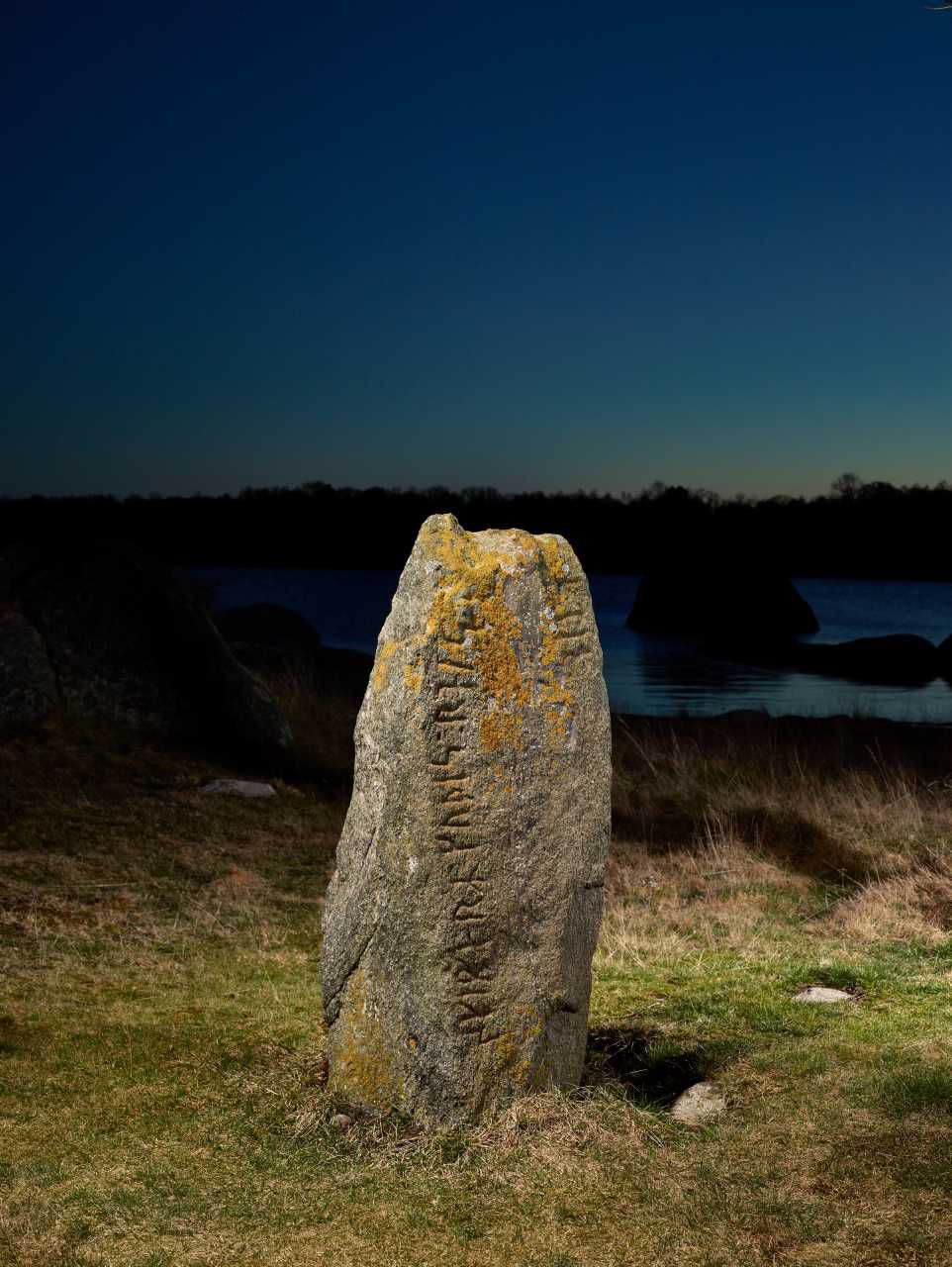
Roberto Fortuna photographed the stone for the National Museum of Denmark in 2015. It documents the carved stone in a coastal setting. Its lighting makes parts of the inscription visible, but the published reading remains necessary where the surface is damaged.
Sources: DR 363 — Samnordisk runtextdatabas 2020 in Runor · DR 363 — catalog coordinate fields · Sturkö-runesten — Roberto Fortuna, March 11, 2015, DMR-189121
Sources and further reading
- DR 363 — Samnordisk runtextdatabas 2020 in Runor · Uppsala University / Riksantikvarieämbetet
- DR 363 — catalog coordinate fields · Uppsala University / Riksantikvarieämbetet
- Sturkö-runesten — historical photograph DMR-5373 · Nationalmuseet, Denmark
- Martin Hansson, Blekinge och Danmark (2024), p. 301 · Blekinge museum / Lund University
- Sturkö-runesten — Roberto Fortuna, March 11, 2015, DMR-189121 · Nationalmuseet, Denmark
- Reusing and citing the runic database · Riksantikvarieämbetet
Original factual summary from Samnordisk runtextdatabas 2020, Department of Scandinavian Languages, Uppsala University, through Runor; DR 363; http://kulturarvsdata.se/uu/srdb/8b591aa9-32f4-4073-b2e2-d504e17de48a. Additional scholarship is identified at each section. Reviewed 2026-11-02.
Source check: 2026-11-02. Readings and dates can change as research develops.