

Literature · Languages · Historical evidence
Where Tolkien’s Middle-earth Met the Norse World
Names, Dwarves, Halls, Runes, Kingdoms, and the Evidence Behind the Parallels
About 27 minutes to read · Sources reviewed November 13, 2026
Introduction: Tolkien did not simply turn Vikings into fantasy
Why do the names of Tolkien’s dwarves sound like they belong in the old North? Why does Gandalf recall a wandering god, and why do the riders of Rohan seem to inhabit a world of great timber halls and inherited obligations? These are inviting questions because the links are real, but also easy to oversimplify. J. R. R. Tolkien was a scholar of early languages and literature as well as the creator of Middle-earth. His fiction draws from centuries of different traditions, not one homogeneous collection of 'Viking myths.' [S04, S46]
Some connections can be demonstrated with unusual precision. The medieval dwarf-name material in Völuspá and Snorri’s Edda can be compared with names in The Hobbit; John D. Rateliff identifies the wider naming relationship, while the edition-specific discussion below keeps individual spellings and exceptions separate. Rohan has a strong Old English literary and linguistic layer. Tolkien’s own Bretherton letter identifies Kullervo as an early stimulus for his legend-making. These are distinct kinds of evidence: a textual correspondence, a scholar’s account of naming, and the author’s retrospective testimony. [S14, S19, S23, S25, S31, S34]
The most useful way to read Middle-earth beside the Viking Age is therefore not to hunt for a secret one-to-one map. It is to ask which language, text or historical practice stands behind a resemblance; whether Tolkien said he used it; how the story transformed it; and what remains speculation. A documentary parallel is different from a modern costume designer’s choice. An imagined kingdom is not an archaeological culture. A medieval manuscript is not an eyewitness report written at a ninth-century funeral. Once those categories are kept separate, the connections become more interesting—not less.
1. Before comparison: which 'North' are we talking about?
The Viking Age is a historical period whose boundaries vary with regional convention. The National Museum of Denmark uses 800–1050; the Swedish National Heritage Board’s introductory account extends it from about 800 into the early twelfth century. These working periods should not be confused with the dates of surviving mythological manuscripts. The Poetic Edda’s Icelandic Codex Regius, GKS 2365 4to, is dated to about 1270; Snorri Sturluson’s Edda is an early thirteenth-century work. Earlier traditions may survive in these texts, but a manuscript’s date does not establish the composition date of every poem it contains. [S23, introduction pp. 1–2; S37a, S37b]
Beowulf adds another layer. It is an Old English heroic poem set among legendary Danes and Geats. The British Library dates the Nowell Codex containing its unique medieval copy to the very late tenth or, more likely, early eleventh century. That physical manuscript date is distinct from the debated date of the poem’s composition. Beowulf is neither an Old Norse saga nor an eyewitness chronicle of the Scandinavian rulers it portrays. Tolkien studied it as poetry, and its monsters, halls and mortality belong in a literary comparison rather than a literal reconstruction of Viking-Age history. [S05, S06, S36]
Finland’s Kalevala belongs to another historical layer. Elias Lönnrot combined and reshaped oral poetry into a literary epic: the Old Kalevala appeared in two parts in 1835–36, followed by an expanded version in 1849. Finnish and Karelian traditions, with important material collected in Ingria, contributed to that process. This was not the recovery of a single unchanged Viking-Age book. Tolkien’s attraction to Finnish and Kullervo therefore belongs alongside his Germanic interests as a distinct strand of his intellectual formation. [S19, S32, S35a, S35b]
2. The philologist who built a world
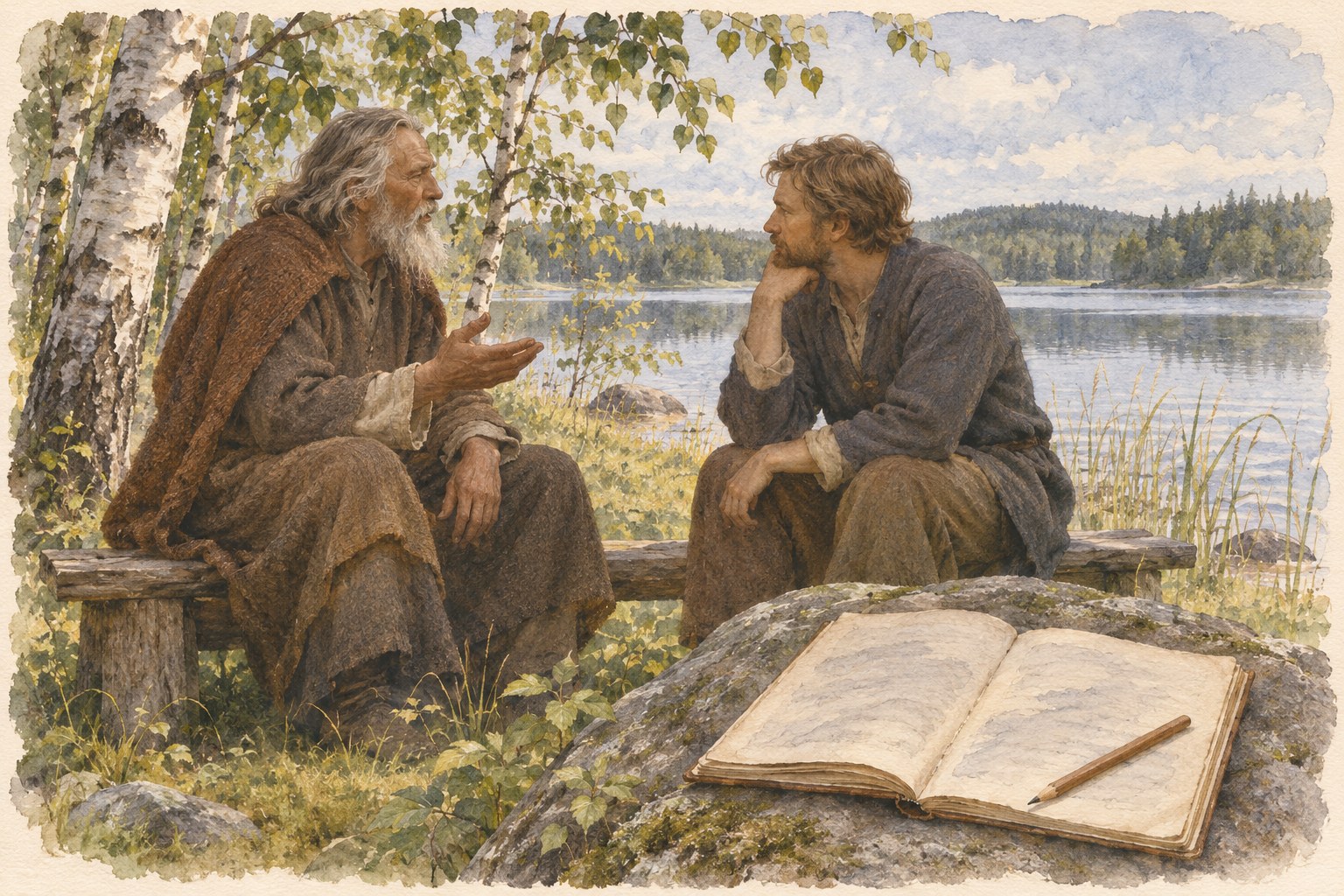
Tolkien’s linguistic work was not a decorative hobby attached to the novels. His account of his own intellectual development makes clear that the making of languages, enjoyment of their sounds and attention to old stories belonged together. In a 1964 letter to Christopher Bretherton, he described his interest in Welsh, Finnish and Gothic and connected the early impulse toward his legendarium to the tragic Kullervo story. In the same letter he discussed how The Hobbit, at first designed as a children’s tale, was gradually drawn toward a larger set of existing legends. He did not present the relationship between the works as a single original blueprint that he had mechanically followed from the start. [S19]
One reason the result feels historical is that names have histories inside the fiction. An invented place can possess several names in several imagined languages. A name may preserve an older form or sound foreign to a particular speaker. The same attention is familiar to students of actual medieval inscriptions and manuscripts: a personal name can change through language contact, translation, misreading or centuries of transmission. Yet a fictional etymology is not evidence for a real historical community. Readers should enjoy Tolkien’s philological realism while keeping the invented languages and ancient languages in their proper categories. [S04, S46]
In a 1951 letter to the publisher Milton Waldman, Tolkien explained his wish to create an interconnected body of legend and discussed the languages, peoples and moral structure of his own imaginative world. The letter is also valuable because it explicitly places Scandinavian and Finnish stories among several materials he admired, not as an exclusive source. It shows an artist consciously combining inheritance and invention. That is a stronger interpretive framework than the notion that his novels could be decoded by replacing every Middle-earth name with a Viking-Age counterpart. [S04]
3. The Dvergatal: why the dwarves of The Hobbit have Norse names
The relationship is clearest when the editions are kept visible. Völuspá contains a catalog of dwarves, often called the Dvergatal. Edward Pettit’s 2023 edition presents the Regius and Hauksbók versions separately. Names corresponding to Durin, Dwalin, Thorin, Nori, Fíli and Kíli occur in both edited lists, but not every familiar form appears in both. Pettit’s Regius text has Glói where his Hauksbók text has Glóinn; Dáinn and Náinn also appear in the Hauksbók list. The differences matter: a modern table should identify which edited witness supplies each form. These are textual correspondences, while the history of Tolkien’s adaptations is a separate question. [S23, S14]
The most instructive examples are not always identical names. Gandálfr occurs among the dwarf names, while Tolkien’s Gandalf is a wizard. Pettit’s notes offer a staff/spirit-elf interpretation of Gandálfr and an oaken-shield interpretation of Eikinskjaldi. The latter provides a clear linguistic comparison with Oakenshield. Such glosses do not turn the medieval catalog into biographies of Tolkien’s characters, and possible name meanings should not be presented as settled etymologies in every case. A 2023 edition helps us read the surviving tradition; it cannot be the edition Tolkien consulted. [S23]
The names are only a beginning. Tolkien made the dwarves of his story into individuals with arguments, ambitions, family histories and distinct narrative roles. Rateliff’s account of composition describes Thorin’s dragon-sickness and Bilbo’s estrangement from his traveling companions in a phase of the drafting. This is evidence about Tolkien’s developing story, not a biography supplied by the medieval name Þorinn. An inherited name and an invented character’s history are different things. [S14]
Exceptions and different textual routes belong in the comparison too. The edited Regius and Hauksbók dwarf lists checked here do not contain Dóri, Óri, Óinn or Andvari in that bounded passage. Corresponding names are present in the Prose Edda, with a critical-print cross-check in Finnur Jónsson’s 1931 edition. That does not establish that Tolkien borrowed each name from this particular edition. Balin and Gimli require separate investigation; absence from the selected lists is not proof of absence from all Norse literature. Andvari belongs primarily in the ring-story comparison, not in a list of names assigned to Tolkien’s dwarf companions. [S23, S31]
Names also moved within Tolkien’s own drafts. John D. Rateliff’s account on the Tolkien Estate website describes an early phase in which the wizard was Bladorthin, the chief dwarf Gandalf, and the dragon Pryftan. The later association of Gandalf with the wizard shows that an inherited name could be reassigned during composition. The transfer itself does not demonstrate every change in characterization. Medieval naming material and Tolkien’s revisions must be studied together. [S14]
4. Gandalf and Odin: a resemblance with limits
The comparison between Gandalf and Odin should begin with what can actually be shown. In the opening chapter of The Hobbit, Gandalf carries a staff and wears a pointed hat; these features invite comparison with images of a traveling wise figure. They do not, by themselves, identify his source or establish that he reproduces Odin’s character. [S34]
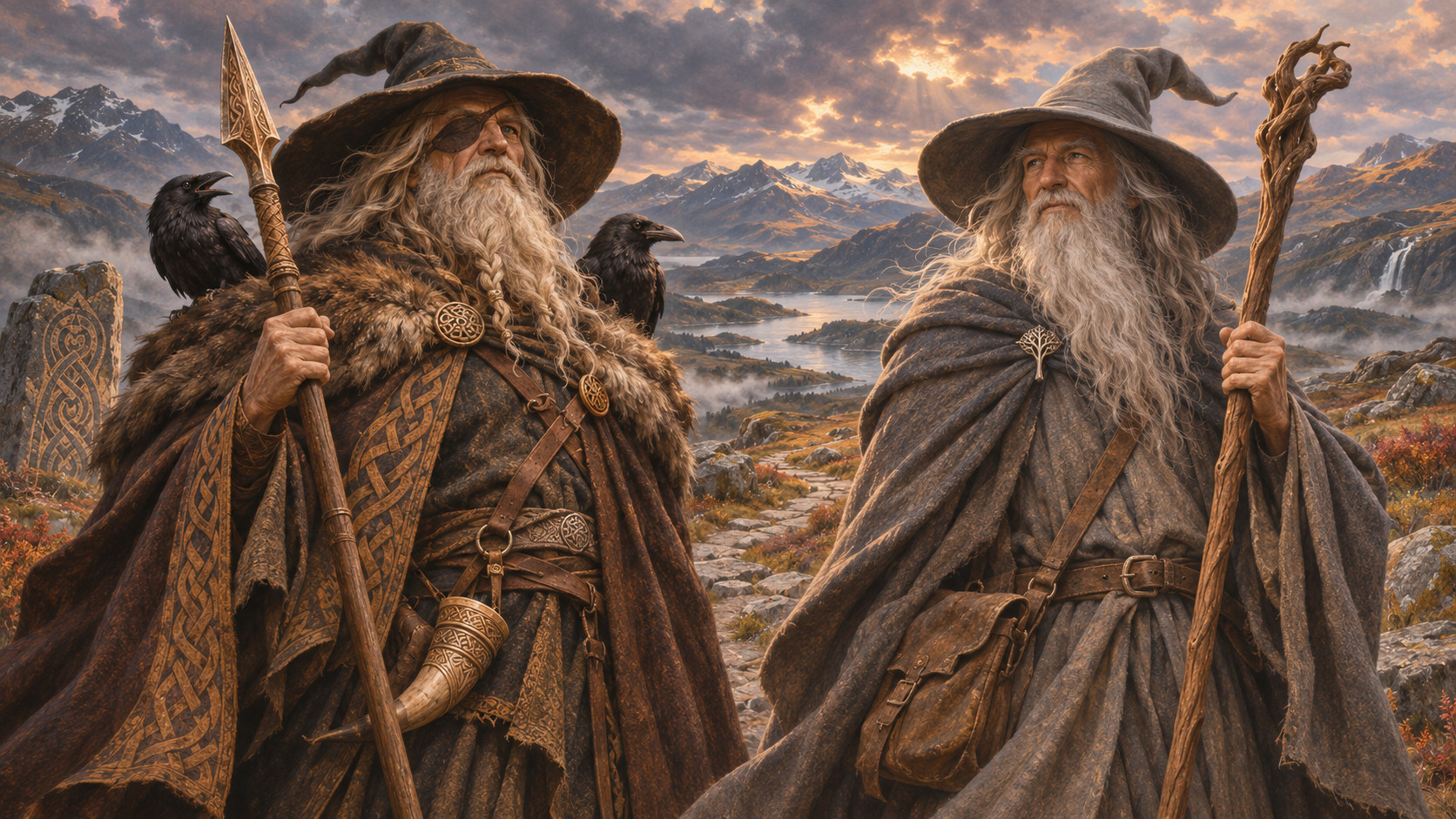
Tolkien’s own account gives the wizard a different frame from an identification with Odin. In the surviving Estate abridgment of his 1951 Waldman letter, the wizards are compared with guardian angels and their powers are directed primarily toward encouraging resistance, cooperation and endurance. This explains a purpose within Tolkien’s fiction; it does not make Gandalf one of the Æsir or establish a one-to-one Norse counterpart. [S04]
Gandalf’s name offers firmer textual ground than an impression of visual resemblance. Gandálfr occurs in the selected medieval dwarf-name lists, and Rateliff discusses the name’s movement between roles in early Hobbit drafts. That naming evidence can coexist with a cautious Odin comparison, but it does not make Gandalf another name for Odin or explain his entire character. The published wizard belongs to Tolkien’s own fictional order, whose purpose must be assessed from Tolkien’s writings. [S14, S23, S04]
5. Rohan: the Old English kingdom that is often called 'Viking'
Rohan’s hall, riders and heroic language can evoke a broad northern literary world. The language evidence is more specific: Oxford’s description of Mark Atherton’s Old English lecture connects Tolkien’s interest in Old English and Mercian with Rohan. The name analyses discussed below give concrete examples of that layer. They do not identify the Rohirrim with an excavated population or turn Rohan into a hidden Scandinavian kingdom. [S25, S27, S28]
Théoden makes the Old English layer tangible: the historical word þeóden denotes a ruler or king, especially in poetic usage. Thijs Porck’s discussion places Éowyn, Éomer, Éomund and Éothéod within a horse-related naming pattern. The relevant dictionary elements include eoh for a horse, wyn or wynn for delight, mǽre for illustrious or famous, mund for protection, and þeód for a people. These lexical meanings support the scholarly analysis; they are not documentary proof of a separate statement by Tolkien about every name. Nor do they turn the fictional characters into historical Anglo-Saxons or Vikings. [S27, S28]
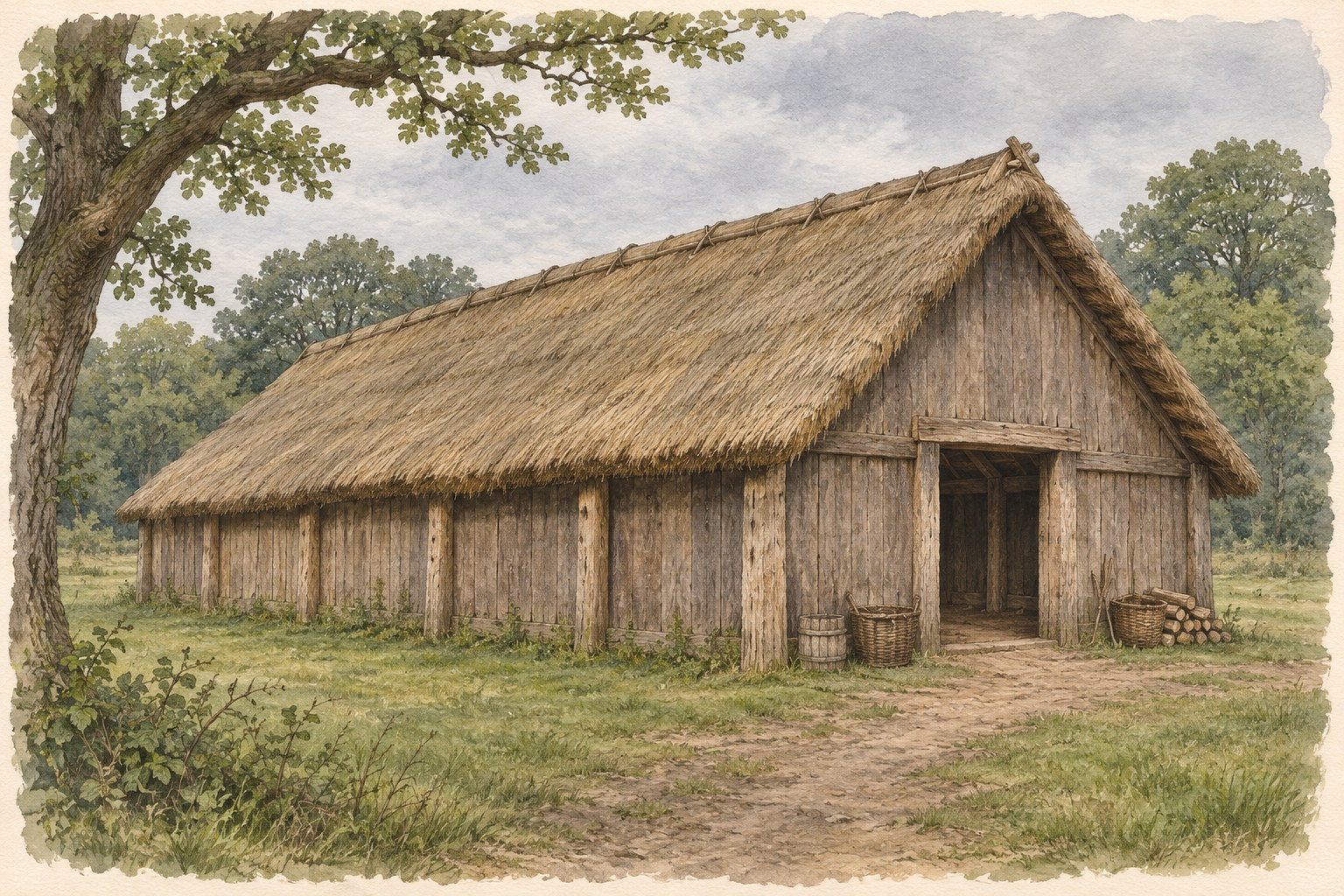
The royal hall invites a comparison across three different kinds of evidence: archaeological buildings, an Old English poem and Tolkien’s fictional architecture. Atherton discusses the arrival at the hall in Rohan in relation to Beowulf’s arrival at the Danish court. That is an attributed literary comparison, not an identification of the fictional building with an excavated Scandinavian hall. A reconstruction drawing should not merge all three and label the result a verified Viking hall. [S25]
The same distinction matters when comparing fictional or legendary armed women with archaeology. A weapon grave must be interpreted through human remains, burial context and other independent evidence. A fictional shieldmaiden cannot establish how often Viking-Age women fought in real battles. Literary comparison can help frame a question, but it cannot answer that historical question on its own.
6. Beowulf, the great hall, and the dragon’s treasure
Tolkien’s relationship with Beowulf is exceptionally well documented because he was both a serious scholar of the poem and a storyteller who worked in a related field of heroic imagination. His lecture 'Beowulf: The Monsters and the Critics', delivered in 1936, changed the terms of scholarly discussion by insisting that the monsters were central to the poem’s artistic meaning rather than unfortunate distractions from a usable chronicle of northern wars. The Tolkien Estate’s account of the essay places this work firmly within his scholarly career. [S05, S06]
Beowulf’s hall, Heorot, is a place of gift-giving, music and social obligation, but also a place attacked by Grendel. Its meaning comes from the story as well as its architecture. Atherton’s comparison with the hall in Rohan invites readers to consider how Tolkien adapts that literary setting. It does not establish that he copied the dimensions of a particular excavated structure. [S25, S39, S41]
The dragon motif offers another comparison. In Beowulf, an aged hero faces a treasure-hoarding dragon after an object is taken from its hoard. Rateliff’s account of The Hobbit’s composition describes Smaug’s destruction of the kingdom under the mountain and the later development of the treasure story. These works invite comparison through wealth, danger, courage and mortality, while their settings and protagonists remain different. Tolkien’s scholarly immersion in Beowulf makes the comparison meaningful; a shared dragon alone does not prove the origin of every scene. [S05, S14, S39, S41]
The poem’s mood also matters. Heroic reputation is unstable in a world where victory can be temporary and a kingdom’s future uncertain. Tolkien’s fictional histories have the same capacity to place a moment of courage within a longer story of loss. That does not mean the two authors held identical beliefs or that early medieval Scandinavians lived according to the exact moral psychology of a modern fantasy novel. It means Tolkien understood an old poem as literature and drew on its power to imagine a convincing historical depth.
7. The Völsungs: Sigurd, Fáfnir, treasure and the problem of the ring
The Eddic Fáfnir material connects treasure with family violence and danger. In Pettit’s Reginsmál, the dispute over gold belongs to the story of Reginn and Fáfnir; the opening of Fáfnismál describes Sigurðr’s ambush, and stanza 9 warns of death associated with the treasure. These specific passages give the medieval side of a comparison. Tolkien later made his own alliterative retellings, discussed by Christopher Tolkien in connection with The Legend of Sigurd and Gudrún. His modern poems and their synopsis must remain distinct from the medieval texts. [S23, pp. 484–485, 502–505; S09, S16]
Fáfnir and Smaug are useful candidates for comparison because both stories connect dragons with treasure and danger. The Eddic passages place Sigurðr’s encounter within legendary family conflicts; Rateliff describes Smaug within Tolkien’s developing adventure. Those sources support a thematic comparison. They do not make the dragons the same creature or establish that Tolkien transferred each medieval episode into The Hobbit. [S23, S14]
In Reginsmál, Loki takes Andvari’s remaining ring, and the dwarf’s following declaration concerns the destructive consequences of his gold. The ring is then used to cover the last exposed hair of the otter skin. This narrative is more specific than a generic story of an evil ring. Pettit suggests that the scene probably contributed to Tolkien’s One Ring; that is an attributed scholarly interpretation, not a verified declaration by Tolkien or a claim that one medieval object explains the whole novel. [S23]
Tolkien’s own retrospective discussion also complicates any straightforward origin story. In the 1964 Bretherton letter, he explained how the initially modest ring from The Hobbit became the central burden of the larger tale when he connected it to the mythology developing elsewhere. That is direct evidence for literary transformation within his own writing process. It should carry more weight than a claim that any single medieval ring narrative can be identified as the entire explanation of his later plot. [S19]
8. Elves, dwarves, trolls and the danger of treating names as definitions
An old name for a supernatural being does not establish that two authors imagined the same creature. Tolkien’s own account of his peoples provides a useful starting point: in his unsent October 1958 draft continuation of a letter to Rhona Beare, he discusses Elvish longevity and Aulë’s making of the Dwarves within his mythology. That is evidence for his particular account at that stage, not a definition of medieval álfar or dvergar. Comparisons with older texts need their own passages, and the draft must not be treated as an unchanging statement covering every version of the legendarium. [S33]
The same restraint applies to other imagined creatures. A familiar name or visual resemblance does not establish a single medieval source. The anatomy, behavior and role shown in a film may be a modern artistic decision. A literary illustration and a documented medieval representation answer different questions.
9. Language as a map: Old Norse, Old English, Finnish and invented speech
Names carry history in Tolkien’s fiction much as they do in the surviving medieval record, but the histories are not interchangeable. Old Norse is a North Germanic language, Old English a West Germanic language; both belong to the wider Germanic family and share older material. Finnish belongs to another language family. Tolkien was interested in these distinctions rather than using them as interchangeable northern sounds. His invented languages also possessed different aesthetics, grammars and imagined histories. [S04, S29, S32, S46]
Middle-earth invites a linguistic comparison with the Old English middan-geard, whose recorded meanings include the world or earth and its inhabitants. That historical word is directly attested. That attestation does not, by itself, establish the precise route by which Tolkien adopted his English expression or prove a direct borrowing from Old Norse Miðgarðr. A shared Germanic vocabulary does not by itself make his fictional geography a literal map of Norse cosmology. [S27]
Rohan’s Old English layer sits beside Tolkien’s invented Elvish languages. Carl Hostetter identifies Quenya and Sindarin as the two principal Elvish languages encountered in the published fiction and distinguishes their real history of revision from their imagined history within Middle-earth. Tolkien’s Auden letter recalls the appeal of Welsh and Finnish, but resemblance and inspiration do not make an invented language a simple substitution cipher for either one. [S25, S29, S32]
The medieval forest-name comparison can also be made more concrete without claiming too much. Pettit’s text has the inflected form Myrkvið in Lokasenna 42 and Atlakviða 3 and 5, using Myrkviðr as the normalized headword. These passages establish medieval occurrences of the name; they do not establish which occurrence Tolkien used, or whether all the properties of his Mirkwood came from one older narrative. That distinction between an attested word and a demonstrated route of borrowing is as important for places as for people. [S23, pp. 300–301, 320 n.105, 662–663]
10. Runes: what Tolkien used, what he invented, and what the Vikings carved
Historical runes and Tolkien’s scripts must be kept separate. The Younger Futhark used in Viking-Age Scandinavia had sixteen signs, as the Swedish National Heritage Board explains. Arden Smith’s study of Tolkien’s writing systems identifies the runes on Thrór’s Map in The Hobbit as an Anglo-Saxon futhorc adapted to represent English. The map is therefore neither a simple chart of the Scandinavian Younger Futhark nor an example of the invented Angerthas system. [S02, S38a]
A rune’s shape is only part of the evidence. In historical Scandinavian writing, one sign could represent several sounds, and values changed over time; the Swedish National Heritage Board illustrates this with the sign used for an earlier nasal vowel and later o. Tolkien’s fictional terminology needs similar care: Smith distinguishes the Tengwar from the Angerthas and calls the individual signs of the latter cirth. These invented systems have their own fictional histories. They should not be presented as alphabets recovered from archaeological inscriptions. [S02, S38a, S38b]
A factual comparison should therefore keep historical Elder Futhark, historical Younger Futhark, historical Anglo-Saxon futhorc and Tolkien’s invented writing systems clearly labeled. Similar-looking signs can belong to different languages and systems. Their identity depends on the source and context, not simply on an ancient-looking shape. [S02, S38a, S38b]
Runes also show why 'Norse' cannot automatically be applied to every northern-looking element in Tolkien. Some parts of his fiction engage with Old English, others with Old Norse, others with Welsh or Finnish, and still others with his own languages. A reader who knows the difference can appreciate more of his design.
11. The kingdoms and places of Middle-earth: parallels without false maps
The question 'Which Viking kingdom is Rohan?' sounds straightforward but begins with a false assumption: a fantasy realm must correspond to one real country. Tolkien’s fictional geography has borders, legends, languages and changes of power. Northern and medieval literature helped him imagine the depth of such a world, but a resemblance in atmosphere is not a geographical identification.
Rohan remains an especially useful case because its presented language has a strong Old English layer. Atherton’s lecture and the historical dictionary entries support that connection. A historical Scandinavian hall can offer a comparison, but it cannot establish a real-world location or archaeological plan for Tolkien’s fictional kingdom. [S25, S27, S28]
For Gondor and Arnor, Tolkien’s own account offers a more useful starting point than a Scandinavian map. In his 1964 Bretherton letter, the author links Númenor to a recurring wave dream and an abandoned time-travel story, then explains how that material joined his wider mythology. He identifies Elendil with the founding of the exiled kingdoms of Arnor and Gondor. This is retrospective testimony about composition and fictional history; it does not establish a single real-world model or settle the etymology of every name. [S19]
The mountain kingdom in Rateliff’s account of The Hobbit offers a different kind of association. A dragon, treasure and lost inheritance can be compared with northern heroic stories. That thematic resemblance does not identify the fictional mountain with a real Scandinavian mountain or mining settlement. The older dwarf-name tradition helps explain some terminology, but it does not make an invented realm a documented Viking archaeological site. [S14, S23]
Mirkwood belongs to the lexical comparison discussed above: medieval occurrences of Myrkviðr provide evidence for a name, not a map of Tolkien’s forest. Different kinds of connection—name, language, literary theme or authorial testimony—should remain distinct. They do not justify assigning every fictional place a Norse equivalent. [S23]
12. The Finnish Kalevala, Kullervo and Tolkien’s tragic imagination
A narrative about the Norse roots of Middle-earth is incomplete if it ignores Finland. Tolkien’s own letter of 16 July 1964 provides unusually direct evidence that the tragic tale of Kullervo in the Kalevala became a formative source for his early attempts to make original legends. He explicitly connected the later story of the Children of Húrin with this early stimulus while emphasizing how far the work had changed. The claim is not a critic's guess about similar-sounding names: Tolkien described the relationship himself. [S19]
The editions of the Kalevala also matter. Lönnrot continued collecting and reshaping material after the Old Kalevala of 1835–36. The 1849 version expanded the Kullervo story into a more unified tragedy, drawing on additional material collected by Daniel Europaeus in Ingria and Ladoga Karelia. The Kalevala Society emphasizes both the oral sources and Lönnrot’s creative editing. A nineteenth-century literary synthesis can preserve older traditions without being a contemporary record of Viking-Age Scandinavia. [S35a, S35b]
The Kullervo sequence can be examined directly in an identified translation of the Kalevala. Kirby’s Runos XXXV–XXXVI describe a disastrous recognition of kinship, revenge and the deaths that conclude Kullervo’s story. Tolkien’s own later account identifies this material as a beginning for his legend-making, while stressing its transformation. That supports a relationship between works, not a claim that every event in the later Túrin narrative translates one Finnish episode. [S43, Runos XXXV–XXXVI; S19]
The authorial evidence also includes language. In his 1955 letter to W. H. Auden, Tolkien recalled the impact of Finnish on his language-making. Hostetter’s account shows why that influence should be discussed alongside decades of revision and invented linguistic history. It supports a connection with Finnish while leaving detailed derivations to specialist, word-by-word analysis. Quenya and Sindarin should not be identified with modern national populations simply because real languages contributed to Tolkien’s imagination. [S29, S32]
13. Ragnarök and the endings of worlds: caution with cosmic comparisons
The ending of Völuspá offers a specific comparison, provided its version is named. In Pettit’s Regius text, stanzas 55–60 move from cosmic destruction to a renewed earth; stanza 63 then presents a corpse-bearing dragon. Even this one textual sequence is more complicated than a simple formula in which disaster produces permanent peace. It may be compared with the ending of ages in Tolkien, but the comparison is an interpretive question. It is not evidence that the War of the Ring or any version of Tolkien’s final battle reproduces the poem’s plot. [S23, pp. 50–53]
Nor is it responsible to convert similarity into a cast list: Sauron does not simply 'equal' Loki, Morgoth is not an alternative name for Odin, and Valinor is not Valhalla. Those names belong to different stories and cosmologies. A more useful comparison asks what each tradition says about loss, pride, loyalty, apparent defeat and renewal, and where their religious or philosophical assumptions differ. When a parallel is only thematic, it should be labeled as such rather than presented as proof of borrowing.
14. The moral world was Tolkien’s own
Religious context also matters. Tolkien’s Waldman letter distinguishes moral and religious meaning within a story from importing a familiar religion explicitly into its fictional world. His daughter Priscilla describes his Roman Catholic background when interpreting Leaf, by Niggle. Her reading helps establish biographical and interpretive context; it is not a license to assign every Middle-earth figure one fixed theological identity or one Norse counterpart. [S04, S44]
Tolkien’s September 1963 letter to Eileen Elgar offers a specific example. He discusses Frodo’s endurance, the limits of a person under overwhelming pressure, and the importance of mercy toward Gollum. Elsewhere in that letter, he imagines how Gandalf’s rule through the Ring could become oppressive even under a claim to do good. This is a hypothetical warning, not an event in the novel. Such authorial explanations make a comparison of power and heroism more precise than treating every dangerous ring as the same story. [S45]
It is also worth recalling that Tolkien had a long career as a medievalist. His fiction was neither a museum exhibit nor a modern historical novel. It was a constructed secondary world whose emotional credibility depended in part on the apparent depth of its languages and histories. The most accurate account must recognize both his debt to earlier literature and his freedom to change its functions.
15. Archaeology, historical reconstruction and the changing screen image
The popularity of movie adaptations has added another layer between medieval evidence and a reader’s idea of Middle-earth. A film may show a hall, costume, sword, longship or landscape chosen for beauty, narrative clarity or cinematic impact. Even when a designer studies history, the finished image is part of a screen adaptation, not a discovered tenth-century artifact and not an illustration that Tolkien necessarily imagined in the same way. This matters particularly for a history site whose visitors may already associate a certain helmet, cloak or piece of jewelry with 'real Vikings.'
An archaeological photograph, a modern reconstruction and a literary illustration represent different kinds of evidence. A museum object needs an identity and find context; a reconstruction contains interpretive choices; an illustration depicts a story. Recognizing those differences helps prevent a convincing picture from acquiring an authority it does not possess.
Captions and credits help readers make those distinctions. An image of a literary idea should be identified as such. A modern reconstruction should explain its historical basis and its limits. An invented inscription should never be presented as an authentic archaeological object.
16. What can actually be demonstrated?
Several kinds of evidence now support the comparison. Edition-specific dwarf-name lists can be set beside the authorized Hobbit preview and Rateliff’s account of the drafts. Tolkien’s Bretherton letter identifies Kullervo as an early stimulus. Oxford’s lecture description and checked dictionary entries support the broad Old English layer of Rohan. Smith’s analysis distinguishes the Hobbit map’s historical rune tradition from Tolkien’s invented scripts. These sources answer different questions; none by itself proves every proposed borrowing. [S14, S19, S23, S25, S27, S31, S34, S02]
Other connections are interpretations: a resemblance between Gandalf and a traveling wise figure, a comparison of dragon-hoard stories, or a relationship between halls in heroic poetry and modern fantasy. Each depends on the passages and arguments offered for it. A resemblance can be illuminating without proving a particular act of borrowing. [S05, S23, S25, S34, S39, S41]
A third class consists of visible but weak parallels. A helmet similar to a film costume, a tree that reminds the reader of Yggdrasill, a ring in a story, or a kingdom facing disaster can feel northern without establishing a particular act of borrowing. These can be presented as comparisons or invitations to further reading, but not as documented historical origins. Some confident-sounding popular claims should simply be rejected: Rohan is not a proven model of Viking-Age Norway, the One Ring is not automatically Odin’s Draupnir, and Tolkien’s invented runes should not be sold as archaeological runes.
17. Questions readers often ask
Did Tolkien use Norse dwarf names? The checked medieval lists and Hobbit preview show many correspondences, and Rateliff discusses the wider naming relationship. Spellings and inclusions vary between witnesses; some candidates require other texts or remain unresolved. The useful comparison is name by name, without assuming that every character or every part of a character’s story came from one Eddic list. [S14, S23, S31, S34]
Is Gandalf based on Odin? A comparison can be proposed, but the evidence must be separated. The Hobbit’s opening scene supplies Gandalf’s staff and pointed hat. The medieval lists and Rateliff supply naming evidence. Tolkien’s Waldman letter explains the wizards’ encouraging role in his own mythology. None of the checked material makes Gandalf identical to Odin. [S04, S14, S23, S34]
Are the Rohirrim Vikings? They are a fictional people. The checked Oxford account and individual name studies support a strong Old English layer; they do not identify Rohan with a historical Viking kingdom. Similar halls or heroic themes are starting points for comparison, not proof that the fictional people were copied from one archaeological culture. [S25, S27, S28]
Does Middle-earth come from the Viking belief in Miðgarðr? The Old English middan-geard is an attested word for the world or earth and its inhabitants. That gives the comparison a wider linguistic context; it does not establish that Tolkien’s entire imagined geography is a Norse map or prove a direct borrowing from Miðgarðr. [S27]
Did Tolkien use real runes? Yes, in the sense that runes appearing on Thrór’s Map in The Hobbit are adapted from the historical Anglo-Saxon futhorc. He also created separate fictional writing systems. Neither should be confused with the Younger Futhark of the Scandinavian Viking Age. [S02]
Is Tolkien’s One Ring the same as the ring in the Völsung legend? The stories share thematic interests in treasure, power and peril, but the objects perform different functions in different narrative worlds. Tolkien’s own account of how the ring in The Hobbit was developed into the central burden of its sequel is particularly relevant. [S23, S19]
What does the Kalevala have to do with Tolkien? Tolkien identified Kullervo as an early stimulus for his legend-making, transformed in his later work. The Kalevala drew on Finnish and Karelian oral traditions through Lönnrot’s nineteenth-century editorial work. It is not a Viking saga or an unchanged ancient book. [S19, S35a, S35b, S43]
18. Conclusion: influence is a history of transformation
Tolkien's engagement with northern traditions can be traced through precise names, languages, letters, and literary texts, but influence was not simple reproduction. Old Norse, Old English, Finnish, later medieval narrative, and Tolkien's own invention played different roles. Historical evidence establishes some connections directly; other similarities are best treated as interpretations or shared themes. Keeping those distinctions visible makes both medieval sources and Middle-earth more intelligible.
That creative transformation is the reason a comparison belongs on a history website. It can introduce readers to real medieval texts and to what archaeologists can—and cannot—prove about Viking-Age lives. It can also correct the temptation to regard modern fantasy pictures as reliable historical evidence. The result is not a smaller version of Middle-earth. It is a clearer view of both the older traditions Tolkien loved and the imaginative work that made his fictional world distinct.
Sources
- [S02] Arden Smith, ‘Writing Systems’, Tolkien Estate. Distinguishes the adapted Anglo-Saxon runes in The Hobbit from Tolkien’s invented scripts. https://www.tolkienestate.com/scholarship/arden-smith-writing-systems/
- [S04] J. R. R. Tolkien, letter to Milton Waldman (1951), authorized abridgment published by the Tolkien Estate. https://www.tolkienestate.com/letters/letter-to-milton-waldman-publisher-1951/
- [S05] Tom Shippey, ‘The Monsters and the Critics and Other Essays’, Tolkien Estate. https://www.tolkienestate.com/scholarship/tom-shippey-the-monsters-and-the-critics-and-other-essays/
- [S06] Leo Carruthers, ‘Understanding Beowulf’, Tolkien Estate. https://www.tolkienestate.com/scholarship/leo-carruthers-understanding-beowulf/
- [S09] Christopher Tolkien, ‘The Legend of Sigurd and Gudrún’, Tolkien Estate. Background on Tolkien’s modern retellings. https://www.tolkienestate.com/writing/christopher-tolkien-the-legend-of-sigurd-and-gudrun/
- [S14] John D. Rateliff, ‘The Hobbit’, Tolkien Estate. A scholarly account of the work’s composition and revisions. https://www.tolkienestate.com/writing/john-d-rateliff-the-hobbit/
- [S16] Christopher Tolkien, ‘The Legend of Sigurd and Gudrún: a prose account’, Tolkien Estate. A synopsis of Tolkien’s retelling, not a medieval source. https://www.tolkienestate.com/writing/the-legend-of-sigurd-and-gudrun-a-prose-account-of-the-story/
- [S19] J. R. R. Tolkien, letter to Christopher Bretherton, 16 July 1964, authorized text published by the Tolkien Estate. https://www.tolkienestate.com/letters/letter-to-christopher-bretherton-a-reader-16-july-1964/
- [S23] Edward Pettit, The Poetic Edda: A Dual-Language Edition (2023), DOI 10.11647/OBP.0308. Völuspá Regius and Hauksbók name lists, pp. 40–41 and 752–753, with selected notes; Reginsmál and Fáfnismál, pp. 482–485, 490–491 and 502–505; Regius Völuspá 55–63, pp. 50–53; Lokasenna 42, pp. 300–301 and 320 n.105; Atlakviða 3 and 5, pp. 662–663; introduction, pp. 1–2. https://doi.org/10.11647/OBP.0308
- [S27] Bosworth–Toller, An Anglo-Saxon Dictionary Online, Charles University. Entries for þeóden, eoh, wyn/wynn, mǽre, mund, þeód and middan-geard. https://bosworthtoller.com/
- [S28] Thijs Porck, ‘The Medieval in Middle-Earth: Horses!’, 5 June 2017. Attributed scholarly analysis of the horse-related names. https://thijsporck.com/2017/06/05/horses/
- [S31] Finnur Jónsson, ed., Edda Snorra Sturlusonar (Copenhagen, 1931), p. 21. A critical-print cross-check of names, not evidence that Tolkien used this edition. https://www.septentrionalia.net/etexts/finnur_SnE.pdf
- [S25] Mark Atherton, ‘Old English’, Oxford/Bodleian lecture, added 31 October 2018. The lecture discusses Rohan’s Old English layer and the hall-arrival comparison with Beowulf (approximately 41:07–41:30). https://podcasts.ox.ac.uk/old-english
- [S29] Carl Hostetter, ‘Tolkien’s Invented Languages’, Tolkien Estate. https://www.tolkienestate.com/scholarship/carl-hostetter-tolkiens-invented-languages/
- [S32] J. R. R. Tolkien, letter to W. H. Auden, 7 June 1955, authorized text published by the Tolkien Estate. https://www.tolkienestate.com/letters/letter-to-the-poet-w-h-auden-7-jun-1955/
- [S33] J. R. R. Tolkien, unsent continuation draft to Rhona Beare, October 1958, authorized text published by the Tolkien Estate. One stage in the author’s evolving account. https://www.tolkienestate.com/letters/letter-to-a-reader-rhona-beare-oct-1958/
- [S34] J. R. R. Tolkien, The Hobbit, publisher-authorized Book2look preview, Chapter I, ‘An Unexpected Party’. Initial spreads used for names and Gandalf’s staff and pointed hat; pagination is not asserted for other editions. https://www.book2look.com/book/9780395873465
- [S35a] Kalevala Society, ‘The Kalevala: Introduction’, based on Irma-Riitta Järvinen, Kalevala Guide, second edition (SKS, 2017). https://kalevalaseura.fi/en/the-kalevala-introduction
- [S35b] Kalevala Society, ‘Elias Lönnrot’s Kalevala Process’. Compilation and edition history. https://kalevalaseura.fi/en/elias-lonnrots-kalevala-process
- [S36] British Library, Cotton MS Vitellius A XV, catalog record 040-001102971. Manuscript description and dating, rather than a new examination of the manuscript leaves. https://searcharchives.bl.uk/catalog/040-001102971
- [S37a] National Museum of Denmark, ‘The Viking Age’. The Danish period convention used here is 800–1050. https://en.natmus.dk/historical-knowledge/denmark/prehistoric-period-until-1050-ad/the-viking-age/
- [S37b] Swedish National Heritage Board, ‘Allmänt om runor’, ‘Den vikingatida runraden’. Introductory Swedish period convention; the same page as S38b. https://www.raa.se/kulturarv/runor-och-runstenar/runskolan/allmant-om-runor/
- [S38a] Swedish National Heritage Board, ‘Att läsa runor och runinskrifter’. Historical rune rows, transliteration and sound values. https://www.raa.se/kulturarv/runor-och-runstenar/att-lasa-runor-och-runinskrifter/
- [S38b] Swedish National Heritage Board, ‘Allmänt om runor’. The same source page as S37b, not an independent witness. https://www.raa.se/kulturarv/runor-och-runstenar/runskolan/allmant-om-runor/
- [S39] Beowulf, translated by Francis B. Gummere, Harvard Classics 49 (1910), Internet Medieval Sourcebook, Fordham University. Selected hall and dragon passages in an older translation. https://sourcebooks.fordham.edu/basis/beowulf.asp
- [S41] Oxford CLASP, Beowulf A.4.1, digital Old English text. Selected hall and dragon passages; no single base edition is inferred from the database bibliography. https://clasp.ell.ox.ac.uk/db-latest/poem/A.4.1
- [S43] Elias Lönnrot, Kalevala: The Land of Heroes, volume II, translated by W. F. Kirby, Project Gutenberg ebook 33089. Runos XXXV–XXXVI, in an older translation and normalized web transcription. https://www.gutenberg.org/files/33089/33089-h/33089-h.htm
- [S44] Priscilla Tolkien, ‘Leaf, by Niggle’, Tolkien Estate. Biographical and interpretive context. https://www.tolkienestate.com/writing/priscilla-tolkien-leaf-by-niggle/
- [S45] J. R. R. Tolkien, letter to Eileen Elgar, September 1963, authorized text published by the Tolkien Estate. Discussion of Frodo, mercy and hypothetical use of the Ring; no printed-edition page number is assigned. https://www.tolkienestate.com/letters/letter-to-eileen-elgar-september-1963/
- [S46] Tom Shippey, ‘J. R. R. Tolkien and Philology’, Tolkien Estate. https://www.tolkienestate.com/scholarship/tom-shippey-j-r-r-tolkien-and-philology/