
Viking crafts · Follow the making
Clinker Boatbuilding: From Tree to Working Hull
Follow the decisions behind overlapping planks, iron fastenings and naturally curved frames, with excavated Viking ships kept distinct from modern experiments.
Explore the craft ↓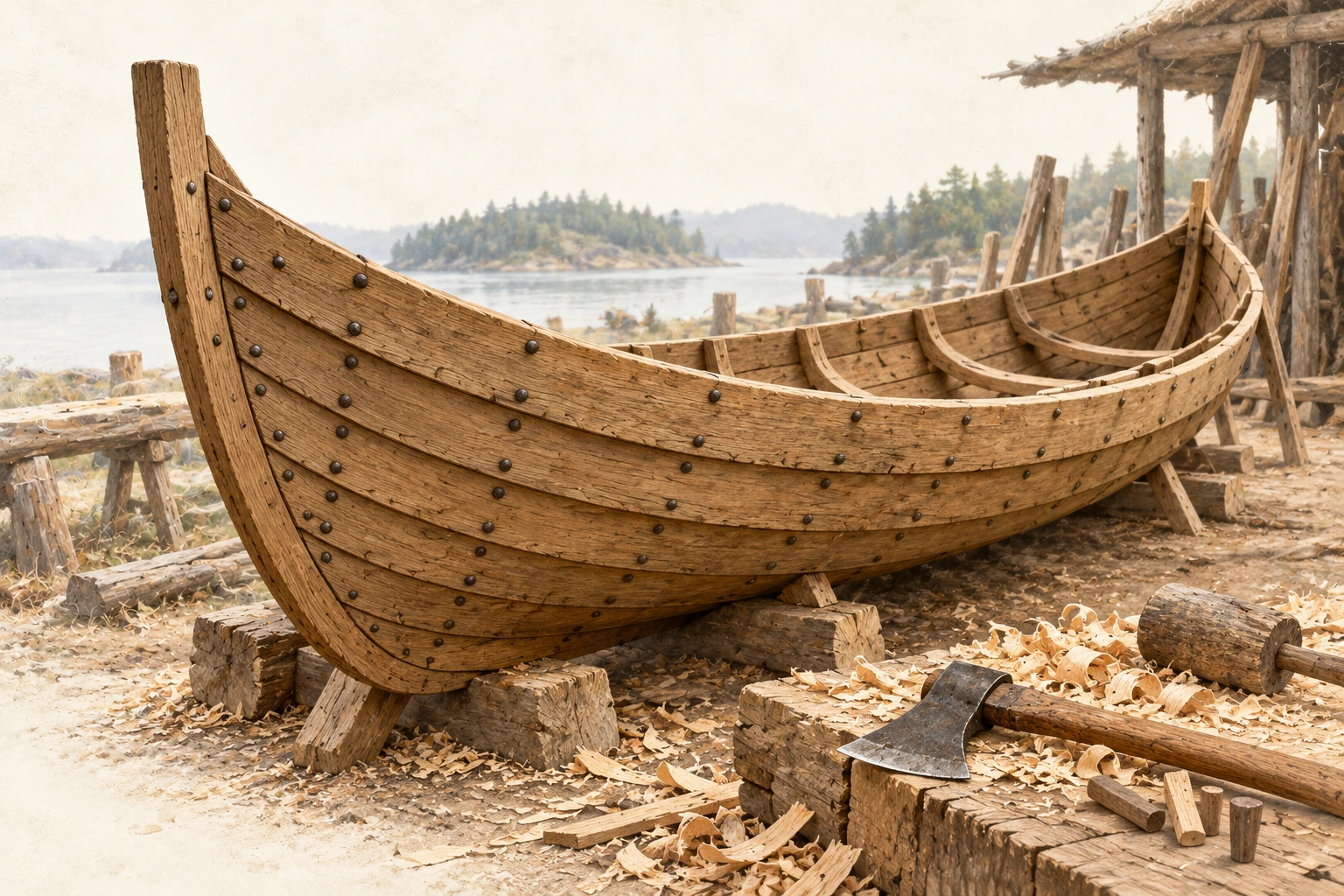
01 · Clinker boatbuilding
Begin with a particular boat
A boatbuilder needs a purpose before a plank: what must the vessel carry, and in which waters? For a grounded starting point, consider Skuldelev 3, an oak coastal trader built in Denmark around 1040. About three quarters of its hull survives. Its open central hold and loose deck planks fore and aft show a working arrangement very different from a long rowing warship. Begin your study by sketching the surviving hull and marking missing areas separately. The guide below explains a construction sequence through archaeological finds and museum experiments; it does not offer one universal Viking blueprint. For vessel types and sailing context, continue with Viking ships and seafaring. [B1]
02 · Clinker boatbuilding
Understand what the overlapping planks do
Clinker construction joins the edge of one plank over its neighbour. A continuous row of planks is a strake; the narrow surface where adjacent strakes meet is the lap, or land. These overlapping edges contribute to the hull’s strength along its length. Internal framing supports the form without turning the vessel into a rigid box. The Viking Ship Museum emphasizes that cleaving and shaping wood along its grain could produce strong, relatively light parts. Look at an actual hull photograph from both directions: outside, follow the stepped edges; inside, distinguish long planks from the timbers crossing them. The overlap is a structural relationship, not simply a decorative stripe across the boat. [B2]
03 · Clinker boatbuilding
Choose the tree, then split and hew
A straight plank begins with suitable timber, not with an axe alone. The museum’s Gislinge experiment selected large oak with straight growth and few knots, split it radially with wedges, and reduced the resulting pieces with axes. Radial splitting follows the tree’s structure; it does not produce the same board as cutting arbitrarily across the grain. Twisted growth can follow the split, making selection and subsequent shaping inseparable decisions. Gislinge itself dates to 1130, so this is an early medieval comparison within the clinker tradition. Examine the broad facets left by hewing and the finer finishing marks. Surviving ship timbers, rather than an assumption that Vikings lacked saws, are the basis for reconstructing an axe-led sequence. [B3]
04 · Clinker boatbuilding
Establish the keel and the ends
The keel establishes the bottom’s centre line; stem pieces close the hull at its ends. Their shape constrains how later strakes can rise, twist and meet. The museum’s account of Gislinge shows a T-shaped keel and stepped stem pieces, shaped from solid timber. This is a useful way to understand why the builder must plan joints before adding the shell. It is not a template to copy onto every excavated Viking boat: end structures and fastening details must be checked against the chosen find. In a model, mark the two sides of the keel clearly and position both ends before adding any strip. A small alignment error here will become visible across the growing hull. [B4]
05 · Clinker boatbuilding
Grow the shell while the wood is workable
The hull takes shape as strakes are fitted to the keel and to one another. Each new plank must meet a changing three-dimensional curve while maintaining a sound lap. The museum’s 2022 Skuldelev 3 reconstruction, Estrid Byrding, used freshly worked, wet oak; its builders could twist the supple planks into place without boiling or steaming. This is valuable experimental evidence, not proof that every Viking builder used exactly the same method. Its seams contain tarred, three-strand wool thread, following material found in the original hull. Treat the fitted wood, the compressed sealing material and the fastenings as a connected joint. A convincing reconstruction image should show thin overlapping boards, not thick stacked beams disguised as planking. [B5]
06 · Clinker boatbuilding
Fasten the lap with rivet and rove
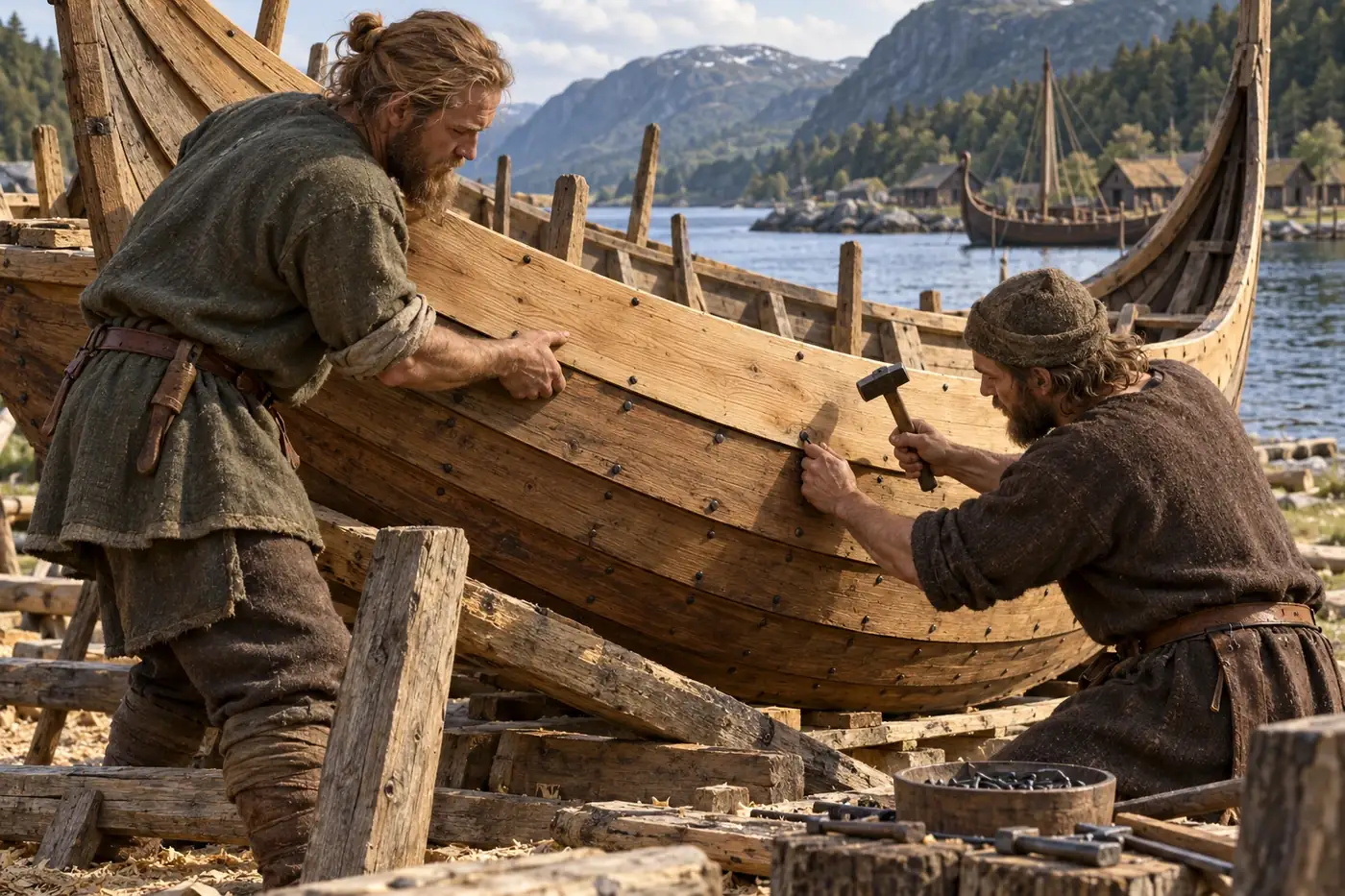
Iron fastenings make the plank joint readable. In the museum’s illustrated method, a hole passes through both overlapping boards. A rivet is inserted, a small iron plate called a rove is placed over its projecting shank, and the end is hammered over to hold the assembly. The round head outside and the peened fastening inside belong to the same connection. The operation needs support on the opposite face; striking an unsupported plank is not an adequate substitute. Exact spacing, dimensions and fastening choices belong to individual finds. The wider Nordic boatbuilding record also includes sewn connections, so do not describe iron riveting as a single sudden invention that instantly replaced every other tradition. [B6]
07 · Clinker boatbuilding
Fit transverse timbers to the shell
Internal framing preserves the hull’s shape and supports the loads placed on it. A floor timber crosses the lower hull; futtocks continue framing up the sides, while crossbeams and knees can support and connect other parts. The names describe jobs, not a compulsory identical arrangement in every vessel. The Gislinge project explains why naturally curved wood matters: a timber growing in the required curve can retain grain that follows its shape. Cutting a similar outline across straight grain produces a different piece mechanically. Read a reconstruction from the bottom upward, noticing where each timber bears against the planking. The practical question is how the fitted parts cooperate, not how many impressive-looking ribs can be added. [B7]
08 · Clinker boatbuilding
Make room for steering and movement
A working hull must accommodate people and equipment as well as water pressure. Viking ship finds including Gokstad and Oseberg preserve evidence for a steering oar or side rudder mounted to starboard. The arrangement differs from the later central sternpost rudder familiar on many boats today. A blade alone cannot explain the system: its attachment must permit useful movement while transferring force to the hull. The museum’s trials with different lashings illustrate how reconstructions can expose practical problems, but successful modern trials do not automatically identify an original missing material. When drawing this stage, show the side-mounted steering position and leave uncertain attachment details unobtrusive. Avoid combining fittings from several ships into a supposedly exact archaeological portrait. [B8]
09 · Clinker boatbuilding
Record what the reconstruction changes
The museum’s reconstruction of a small boat buried with the Gokstad ship offers an unusually useful lesson in method. Its account distinguishes archaeological observations from choices made while building a new boat. Some reconstruction planks were radially sawn after careful timber selection because suitable oak was scarce; that economical modern decision is not evidence that the original planks were produced that way. The account also discusses fitting wood, grain direction and shaping difficult curves. Keep a workshop record with three columns: surviving trace, proposed explanation, modern decision. Such a record makes the finished boat more informative. It also prevents a photograph of a successful replica from silently becoming the sole authority for ancient tools and procedures. [B9]
10 · Clinker boatbuilding
Read repairs as part of the craft
A boat’s working life could alter the builder’s first arrangement. Skuldelev 5 preserves a particularly clear example: damaged upper strakes were replaced with planking from another vessel. The reused material carried oar openings that did not match their new positions. These openings were closed, and new ones made where needed. The repairs turn an apparently awkward detail into evidence for practical adaptation and the value of worked timber. Look for interruptions, redundant holes and changes in workmanship before assuming every feature belongs to the original design. A repaired hull is not a failed version of an ideal boat. It records later decisions by people keeping a useful vessel afloat with the material available to them. [B10]
11 · Clinker boatbuilding
Follow the hull into other workshops
Boatbuilding draws on more than woodworking. Smiths supply and maintain iron tools and fastenings; rope makers and textile workers create components needed to equip a sailing vessel. The museum treats these crafts as connected, because one material choice can affect the demands placed on another. A hull without rigging, sail and suitable fittings is an incomplete account of a working ship. For your own process sheet, list the parts visible in a reconstruction and identify which depend on a different craft. Do not convert one modern team’s hours into a timeless Viking productivity figure. Explore the separate shipbuilding labour and resources study for the limits of work records and claims about organization. [B11]
12 · Clinker boatbuilding
Test a question, not a legend
For a simple learning exercise, overlap flexible card strips and compare them with strips laid edge to edge. This illustrates the geometry of a lap; it does not reproduce the strength of oak, the effect of iron fastenings or a watertight seam. Write down exactly what your model can demonstrate. Full-size experiments demand the same discipline at a much larger scale. The Viking Ship Museum describes a reconstruction as a historical hypothesis: building and sailing it may reveal new questions, but success does not prove every reconstructed detail. Return to the surviving timbers, toolmarks and joints after the experiment. The strongest craft account moves continually between the excavated object, the maker’s practical experience and the limits of what each can establish. [B12]
Follow the evidence
Sources & further reading
Follow the dated finds, published studies and documented experiments behind each section. Modern demonstrations explain workable choices; they do not establish one method for every Viking-Age workshop.
- Viking Ship Museum — Skuldelev 3, the coastal traderSkuldelev 3, Denmark c.1040. Performance estimates and restored dimensions depend on reconstruction.
- Viking Ship Museum — The hull of the shipMuseum synthesis of clinker construction and grain-following timber use.
- Viking Ship Museum — Gislinge project: planksModern reconstruction of a boat dated 1130; a clearly labelled medieval comparison, not direct evidence for every Viking vessel.
- Viking Ship Museum — Keel and stemGislinge construction example with a T-shaped keel and stepped stems; detailed joints vary between vessels.
- Viking Ship Museum — Estrid Byrding2022 reconstruction of Skuldelev 3; distinguishes original toolmarks and wool seal from modern construction choices.
- Viking Ship Museum — IronRivet and rove mechanics documented in a modern boatbuilding project.
- Viking Ship Museum — FramesFrame elements and naturally grown crooked timber; medieval Gislinge comparison.
- Viking Ship Museum — Rudder and tackleStarboard side rudders on Viking finds; distinguish modern lashing experiments from original fittings.
- Viking Ship Museum — The Gokstad boatModern reconstruction of an excavated small boat. Some modern planks were radially sawn to conserve timber: not historical proof of sawing.
- Viking Ship Museum — Helge AskOriginal Skuldelev 5 repair/reuse evidence. Decorative features of the reconstruction are not secure original details.
- Viking Ship Museum — The ship’s craftsmenConnected specialist crafts and experimental work.
- Viking Ship Museum — Experimental archaeologyReconstruction explicitly presented as a historical hypothesis, tested against several bodies of evidence.
Continue the exploration