
Stage 01
Harvest the whole stem
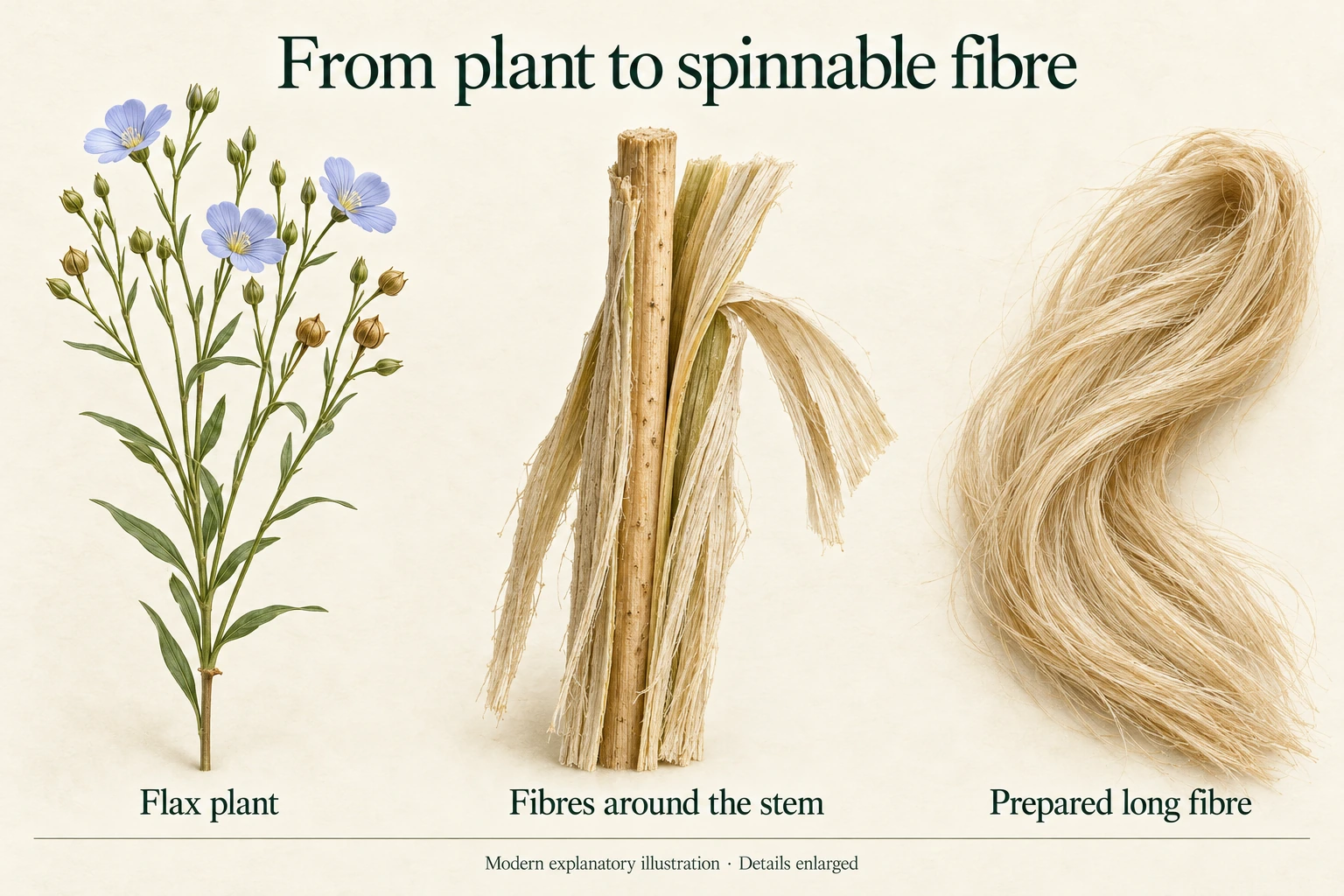
Long bast fibres run along the outer part of the stalk. Modern craft reconstructions often pull flax rather than cut it so the full stem length is kept.
Viking crafts · illustrated deep exploration
Pull the stalk. Remove the seeds. Ret, dry, break, scutch and comb. The result is a bundle of long plant fibres ready to become thread—but every stage leaves different traces, and some leave almost none.
Inside this guide
01 · Material before thread
Flax fibre is not the soft centre of the stem. Useful bast fibres run in bundles near the outside and are held to the woody tissues by plant compounds. To make fine fibre, the stem must be biologically weakened and then mechanically cleaned. That is why the route from plant to thread has several distinct stages rather than one simple “comb the stalk” operation.
Modern experimental projects help demonstrate the sequence, but the precise tools, timings and workshop routines in those projects are not automatically Viking-Age facts. The Viking Ship Museum explicitly presents its Gislinge flax sail as experimental work. [1]
02 · Keep the stem long
In the Viking Ship Museum's reconstruction, flax is pulled rather than cut so as much of the stem length as possible is retained. The logic is straightforward: long stems can provide long fibre bundles. That is a useful experimental principle, but hand pulling itself is difficult to detect archaeologically. [1]
03 · Seeds first
A ripple is a comb-like tool used in the museum's experiment to pull seed capsules from the stems. The seeds may be kept for the next sowing, food or oil. The crucial archaeological point is that flax seeds do not by themselves prove linen production. [1]
This distinction matters at Tjudnäs on Åland. There, masses of almost 100,000 charred flax seeds dated to AD 880–1020 were interpreted as residues from oil pressing. That is excellent evidence for flax cultivation and use, but not direct proof that those same seeds entered a textile production chain. [6]
04 · Controlled decay
Retting uses microbial activity to weaken the material binding the fibre bundles to the rest of the stem. Water retting submerges the stems; field or dew retting lays them out in moist conditions. Archaeological evidence is uneven because a purpose-built waterlogged pit can survive as a feature while field retting may leave no comparable structure. [3]
Stage 01
Long bast fibres run along the outer part of the stalk. Modern craft reconstructions often pull flax rather than cut it so the full stem length is kept.
Stage 02
A ripple or comb strips seed capsules from the stems. Seeds can be saved for food, oil or the next crop; seed evidence does not automatically prove textile production.
Stage 03
Micro-organisms break down pectins that bind fibre bundles to the woody core. Water retting can leave pits or wells; field/dew retting may leave much less archaeological structure.
Stage 04
The stems must dry before the woody core is broken. Modern experiments use sun drying or controlled heat, but exact Viking-Age routines varied and are not preserved as recipes.
Stage 05
Breaking fractures the brittle inner pith while trying to preserve long fibre bundles. Archaeological 'breaking pits' are interpretations that require supporting evidence.
Stage 06
Scutching removes broken woody fragments. The action and tool form can be demonstrated experimentally, but a modern scutching sword is not automatically a Viking find replica.
Stage 07
Hackling aligns fibres and removes remaining debris and shorter fibres. The resulting long fibres are ready for a distaff and spindle; shorter tow can still have other uses.
05 · Stop the process
After retting, the stems must dry. In the Gislinge experiment, air drying and controlled heated drying are both discussed. Heating can accelerate the work but also risks damaging the crop. The exact drying equipment shown in a modern reconstruction should therefore be labelled as experimental rather than copied as a standard Viking fixture. [1]
Some archaeological sites contain pits with charcoal and heat-affected stones that have been interpreted as possible drying or breaking installations, but such features are not self-explanatory. Similar pits can have other functions. [7]
06 · Break the pith
Once retted and dry, the woody core can be fractured while the longer fibres are preserved. The Viking Ship Museum's project uses a breaking frame. That tool makes the mechanics easy to see, but the demonstration should not be presented as a measured replica unless a particular archaeological tool is being reconstructed. [1]
07 · Remove the shives
Scutching removes the fragments left after breaking. In the museum's modern demonstration, the fibres hang over a board while a scutching sword is swept downward. The point is not to beat randomly but to clear the broken pith while preserving the fibre bundle. [1]
08 · Sort and align
Hackling draws the fibre through toothed combs to remove remaining debris, separate shorter fibres and align the long fibres. The Gislinge reconstruction uses several hackles of different coarseness. That graded sequence is useful experimental practice, but the exact number and tooth spacing belong to the modern project unless matched to specific finds. [1]
Longer, cleaner fibres can be arranged on a distaff for fine spinning.
Shorter fibres separated during hackling remain a useful material, although their final uses vary.
Shives and debris may survive archaeologically more readily in damp deposits than finished cloth.
09 · Fibre becomes thread
After hackling, long fibres can be dressed on a distaff and spun. At that point the craft joins the spinning-and-weaving chain. The Viking Ship Museum's project uses a drop spindle for the experimental sail yarn. [1]
Microscopy gives a different kind of evidence. A study of Late Iron Age plant-fibre textiles in the University Museum of Bergen identified nine sampled textiles as flax. That is direct evidence from surviving cloth fibres rather than an inference from seeds or pits. [5]
10 · Archaeology is selective
At Næs on Zealand, wells containing bundles of flax stems were interpreted as retting pits, and many nearby pit-houses contained textile-working evidence. That combination is much stronger than a single ambiguous feature. [4]
Across southern Scandinavia, retting-pit studies show that some sites preserve plant remains, waterlogged pits, ladders, stones or workshop evidence. But dew retting can occur without a constructed pit, meaning the archaeological record may over-represent water-based methods. [3]
| Evidence | What it can support | What it cannot prove alone |
|---|---|---|
| Flax stems in a waterlogged pit | Strong case for retting when context fits. | The exact duration, season or tool set. |
| Spindle whorls nearby | Textile production in the settlement. | That a specific batch of flax was spun there. |
| Charred flax seeds | Flax cultivation/use. | Linen production without further evidence. |
| Flax fibres in cloth | The textile itself used flax. | Where the plant was grown or retted. |
11 · One plant, several economies
The Åland find is a useful corrective to a textile-centred story. Its seed masses were interpreted as pressed for oil. A community could cultivate flax for more than one purpose, and different parts of the plant may enter different archaeological contexts. [6]
This is why the page avoids a simple equation: flax seed = linen. Textile production is strongest when multiple lines of evidence—plant remains, retting features, tools, workshop context and surviving fibres—support one another.
12 · Modern learning activity
This is a modern teaching activity, not a preserved Viking recipe. Use purchased craft flax or linen-processing samples rather than experimenting with unknown plants or stagnant-water retting.
Follow the whole process: locate the useful fibres in a stem, then follow what each stage removes before spinning begins.
Sources & further reading
Museum documentation of a modern experimental flax-sail project. Useful for the sequence from rippling and retting to breaking, scutching, hackling and spinning. The Gislinge Boat itself dates to about 1130, so the project is not a surviving Viking-Age recipe.
Concise explanation of flax preparation and the museum's warning that no flax sailcloth has yet been recovered from Iron- or Viking-Age excavations.
Study of southern Scandinavian retting structures, including Viking-Age examples and archaeobotanical evidence for flax, hemp and nettle.
Kuml article discussing workshop areas and comparing them with the Viking-Age site at Næs, where wells with bundles of flax stems were interpreted as retting pits and pit-houses as textile workshops.
Microscopy-based study of plant-fibre textiles in the University Museum of Bergen collection; nine sampled textiles were identified as flax.
Open-access archaeobotanical study of Tjudnäs, where charred flax seed masses dated AD 880–1020 were interpreted as residues of oil pressing rather than direct evidence of linen manufacture.
Experimental report comparing archaeological traces with practical flax processing. Useful for seeing why dew retting can leave little direct archaeological structure.
Museum overview of sail reconstruction and the very limited archaeological survival of original sailcloth.