
Viking crafts · An illustrated deep exploration
Plant dyeing.
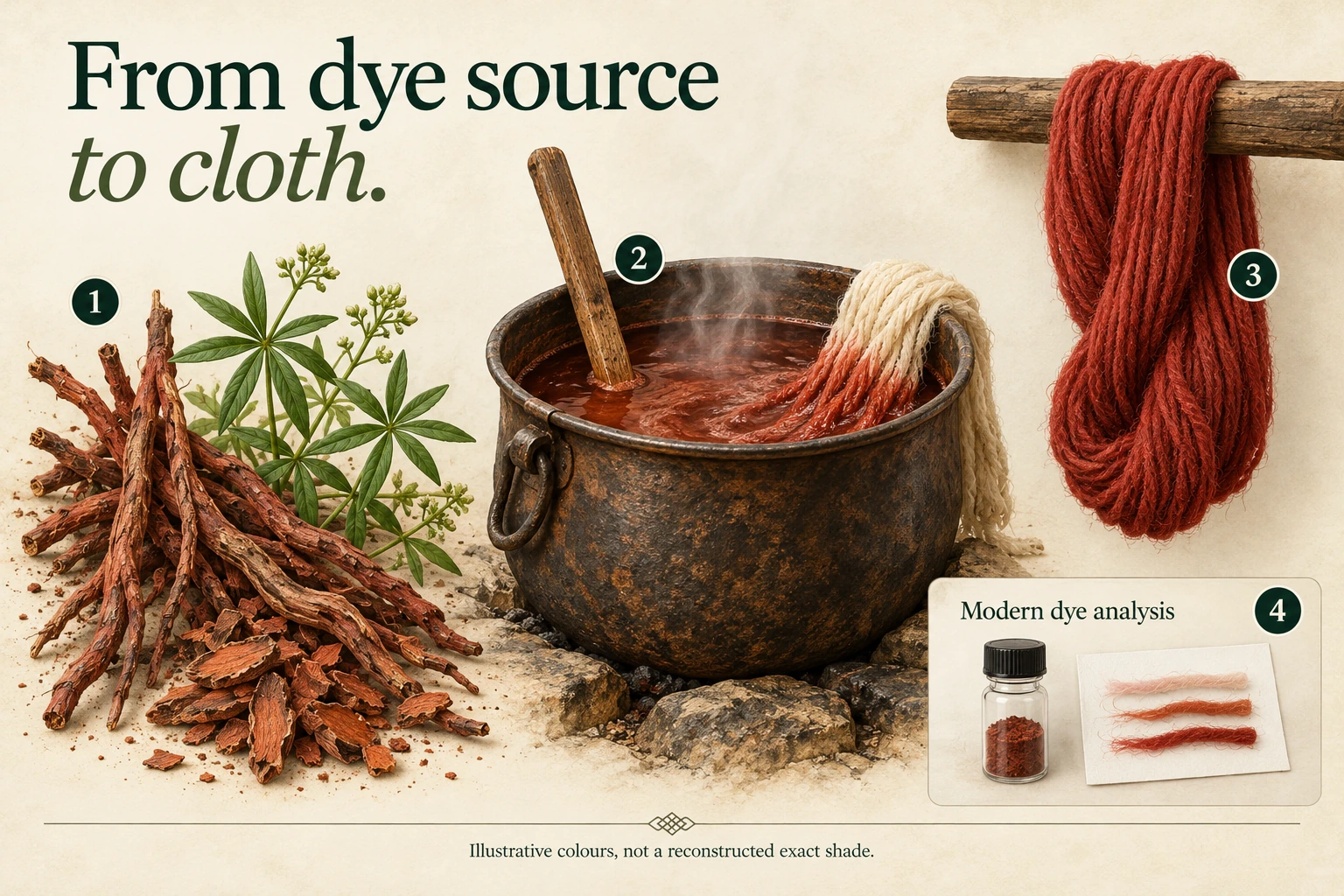
From dye source to cloth.
Follow the evidence from plant remains and coloured fibres to modern dye analysis—and learn why a chemical identification is not the same thing as an exact reconstructed shade.
01 · Evidence first
Colour fades. Molecules can survive.
A thousand-year-old textile rarely looks the way it did when new. Burial chemistry, light, water and conservation change what our eyes see. The strongest starting point is therefore not “what colour is this fragment now?” but “what compounds, fibres and structures can still be identified?” [3] The 2023 study of textiles from Bjerringhøj, Hvilehøj and Hedeby used HPLC-DAD to analyse tiny thread samples. It detected a wider range of dyes than older visual assessments suggested, including red, blue and yellow dye components. But the result is still a chemical signal from a surviving sample, not a perfect photograph of the original garment. [1]02 · Before the dye bath
Start with the fibre.
Wool and plant fibres do not behave identically. Fibre chemistry, yarn twist, weave, previous treatment and wear all affect how colour is taken up and how it survives. Viking-Age textiles include both wool and plant fibres, while silk also appears as an imported luxury material. [8] For a teaching display, place three undyed samples beside one another: wool, linen and silk-like modern sample material. The point is not to claim that they were dyed by one process. It is to show why the substrate must be recorded before comparing colours.03 · What the analyses found
Name dyes only when the evidence supports it.
The 2023 Danish study identified dyer’s madder as the main red dye source in the samples, indigotin consistent with woad or indigo-type sources for blue, and luteolin-containing yellow in selected material. It also identified exotic red dyes such as kermes and European cochineal in high-status contexts. [1] The wording matters. Indigotin is a molecule shared by more than one dye source; it does not always allow the analyst to say “this was definitely local woad.” Likewise, a luteolin signal can point towards a group of yellow-dye sources rather than one certain plant.04 · Follow the working sequence
A dyeing process is a chain, not a single pot.
A useful reconstruction separates preparation, dye extraction, fibre treatment, dyeing, rinsing and drying. The exact historical sequence varies with dye source and textile. Our diagram is therefore a modern teaching model, not a recovered Viking recipe.05 · Blue works differently
Woad is not just another boiling dye.
Blue from indigotin requires a reducing vat process: the colour-forming compound must become soluble, enter the fibre, and then oxidise when exposed to air. Coppergate’s report specifically describes woad as a vat dye involving fermentation and oxidation. [6]06 · Reds and yellows
Madder and yellow dyes need their own stories.
Madder is especially important because it appears repeatedly in archaeological dye analyses. At Coppergate it was the principal red dye identified in the textile samples discussed by Walton, although questions remained about where the dyestuff was cultivated or traded. [7] Yellow dyes are harder to reconstruct from absence alone. Some yellow compounds are less durable or harder to detect after long burial. The newer Danish analyses identified luteolin-containing yellow dyes in selected Viking-Age textiles, demonstrating why improved analytical methods can change the picture. [1]07 · Green, purple and layered colour
A visible colour can have more than one history.
If a fibre carries both yellow and blue dye components it can appear green; combining or layering red and blue can create purple ranges. But this is a chemical and craft possibility, not proof that any particular green or purple reconstruction matches a lost Viking garment. The safest visual approach is to show sample sequences: one undyed fibre, one single-dye sample and one layered modern experiment, each labelled with what was actually done. This teaches colour-building without converting an experiment into archaeological evidence.08 · Fibre, yarn or finished cloth?
The stage of dyeing changes the result.
Colour can be introduced at different stages: loose fibre, spun yarn or woven cloth. The archaeological record does not always preserve enough information to identify the exact sequence for every object. The 2023 analyses sampled both warp and weft from selected textiles, helping researchers see where colourants occur in particular thread systems. [1]09 · A workshop landscape
Coppergate gives more than coloured fragments.
The 16–22 Coppergate excavation is valuable because it combines finished textiles with tools, fibres, dyestuffs and other production evidence. The 1997 volume records 1,147 textile-production artefacts, with more than a thousand dated to the ninth–thirteenth centuries and a substantial Anglo-Scandinavian component. [5] This wider context matters. A bag of plant remains alone does not prove that every plant was used as a dye, while a dyed thread alone may not reveal where the dyeing happened. A workshop interpretation becomes stronger when several independent traces point in the same direction.10 · Colour and status
Rich graves are not the whole population.
Several spectacular dye results come from high-status burials such as Bjerringhøj and Hvilehøj. Those contexts preserve exceptional clothing and imported materials, but they should not become a colour chart for every farm household. The authors of the 2023 study explicitly compare the high-status graves with Hedeby samples, where preservation and detectable dyes differed. [1] This creates a sampling problem: what survives, what is analysed and which graves contained rich textiles all shape the colours visible to us today. The correct conclusion is diversity and uneven evidence—not one universal “Viking palette.”11 · How the laboratory sees colour
A chromatogram is evidence, not a swatch.
HPLC-DAD separates chemical compounds and compares their absorbance spectra with reference materials. The National Museum’s Colour X project explains an important limitation: the method can identify dye molecules without necessarily recovering the exact original visible colour. [3]Schematic only. Peaks are illustrative and do not reproduce a published chromatogram.
This distinction is central to good public history: analytical certainty can be high about a molecule while visual certainty about the original shade remains lower.12 · Try a controlled colour experiment
Make a sample card, not a “Viking recipe”.
For a low-risk educational activity, use a modern natural-dye demonstration chosen from a reputable craft source and label it clearly as modern experimental dyeing. Use dedicated non-food equipment and follow the supplier’s safety instructions for any mordant or dye material. Record four things for every sample: the fibre, the dye source, the treatment sequence and the final appearance. Keep an undyed control beside it. Then compare your record with a named archaeological analysis from this page.Follow the evidence
Sources & further reading
The page prioritises peer-reviewed dye analysis, excavation reports and museum research pages. Modern diagrams explain principles and are not presented as archaeological reconstructions.
- Vanden Berghe, Mannering & Rimstad (2023) — New dye analyses of Danish Viking Age textiles from Bjerringhøj, Hvilehøj and Hedeby
Peer-reviewed HPLC-DAD study of 70 Viking-Age textile samples. Identified woad/indigo, dyer's madder, luteolin-containing yellow dyes, clubmoss and exotic red dyes in selected high-status contexts.
- National Museum of Denmark — Fashioning the Viking Age
Research project on archaeologically grounded Viking-Age textile production and clothing reconstructions.
- National Museum of Denmark — The Quest for Colour X
Explains HPLC-DAD dye analysis and why detected dye molecules do not automatically reveal the exact original visible colour.
- National Museum of Denmark — Clothes and jewellery
Museum overview of Viking-Age clothing, fibres and colouring.
- York Archaeological Trust — Textile Production at 16–22 Coppergate
Major excavation report covering fibre preparation, spinning, weaving, dyeplants, finishing, cutting and stitching; much material dates to the Anglo-Scandinavian period.
- Walton Rogers — Textile Production at 16–22 Coppergate, full report
Discusses raw dyestuffs and evidence for dyeing at Coppergate, including woad, madder, greenweed and weld.
- Penelope Walton — Textiles, Cordage and Raw Fibre from 16–22 Coppergate
Original textile report with dye analysis and discussion of madder, indigotin and preservation limits.
- National Museum of Denmark — Textile technology in the Late Iron Age and Viking Age
Overview of wool, plant fibres, silk and textile techniques in the Late Iron Age and Viking Age.
- National Museum of Denmark — Fashioning the Viking Age 2018–2023
Describes experimental reconstruction of textile qualities based on archaeological finds.
- Ministry of Culture Research Portal — bibliographic record for the 2023 dye study
Institutional record for the peer-reviewed 2023 dye-analysis article.
- National Museum of Denmark — Mammen costume
Museum context for the richly decorated Bjerringhøj/Mammen burial.
- National Museum of Denmark — Fibre
Museum overview of textile fibres and material choices.
- National Museum of Denmark — Weaving
Context for the woven substrates that were subsequently coloured or finished.
- National Museum of Denmark — Finishing
Overview of finishing, sewing, decoration and repair across prehistoric textile production.