
Nalbinding.
From loop to garment.
Follow a single length of yarn through loops made with an eyed needle. Compare technique, shaping, joining and repair with what the archaeological evidence actually preserves.
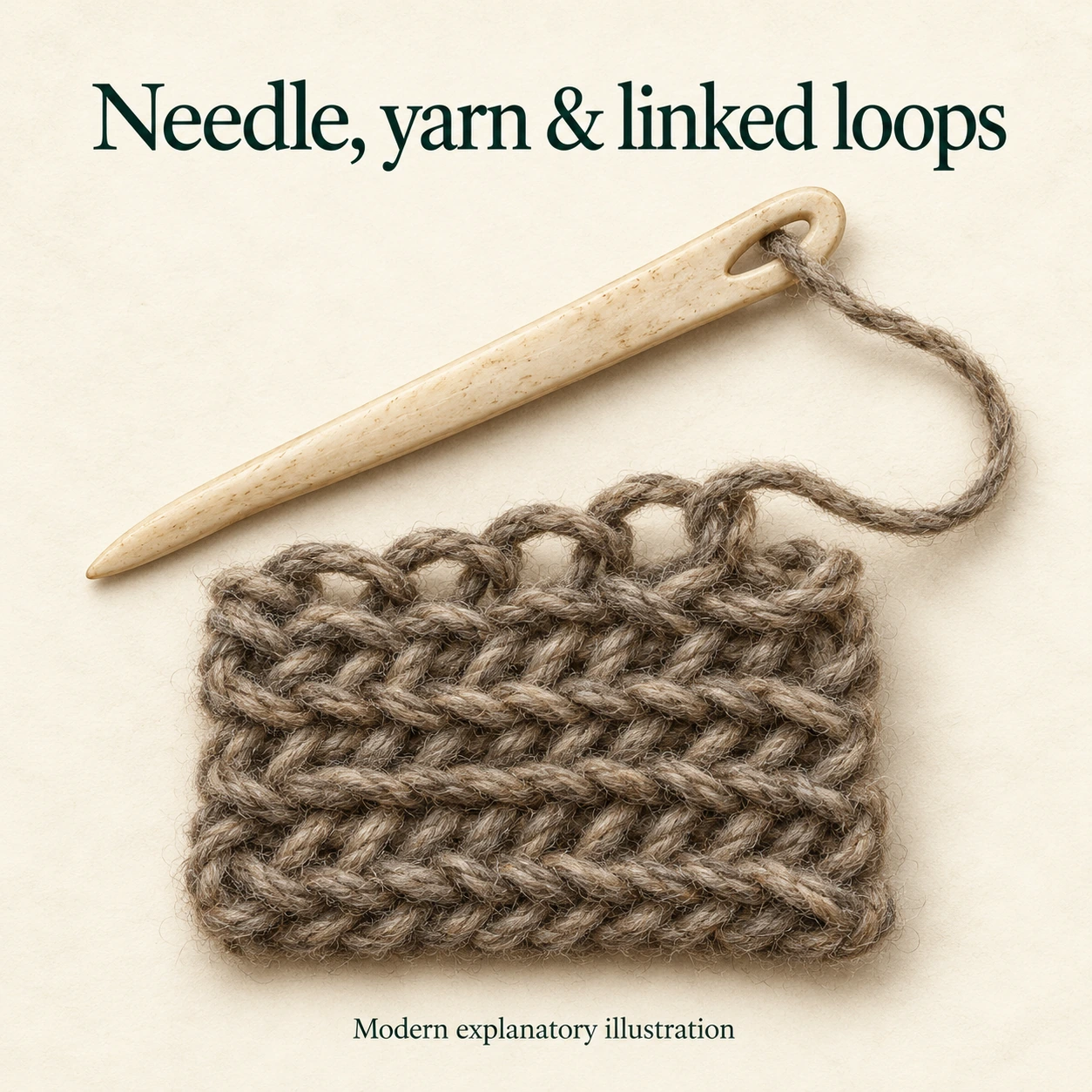
01 · Define the technique
Nalbinding is not knitting with one needle.
Nalbinding builds fabric from loops made with a finite length of yarn carried through the work by an eyed needle. The yarn is repeatedly passed through earlier loops, so the structure cannot normally be unravelled by simply pulling one free end in the way many knitted fabrics can.
Important: modern nalbinding names many stitch variants. A modern stitch name is useful for teaching, but it should not be presented as an original Viking-Age name unless a historical source actually supplies it.
York Archaeological Trust describes the Coppergate sock as made in nalbinding and dates it to c.930–975. [1]
02 · Tools and material
An eyed needle and workable lengths of yarn.
The basic tool is an eyed needle large enough for the chosen yarn. Archaeological sites preserve needles of bone and other materials, but a suitable needle found in a settlement does not by itself prove that it was used specifically for nalbinding. The textile structure provides the stronger evidence for the technique.
Needle
Large eye, smooth edges and enough strength to pass through earlier loops.
Yarn
Wool is particularly useful because new lengths can be joined without bulky knots.
Hands
Loop size and tension are controlled continuously while the new stitch is formed.
The early publication of the Coppergate find notes suitable bone needles from the site, but the sock itself is the direct evidence for nalbinding. [2]
03 · Read one loop
Every new loop connects to earlier work.
Three things to follow
04 · Follow the movement
The needle passes through a changing set of loops.
The original Coppergate publication describes the particular sock stitch as the needle entering the row below and then picking up two loops from the current row. [2]
05 · Continue a finite thread
New yarn has to be joined repeatedly.
Because the whole yarn length must pass through the loops, very long lengths become inconvenient. Modern workers therefore use manageable pieces and join new yarn as work progresses. Wool can often be joined by overlapping and felting or splicing the ends, reducing the need for a hard knot.
This is a modern practical explanation. Archaeological textiles can show the finished structure, but a vanished join may not reveal exactly how a maker joined every new length.
06 · Shape the fabric
Increase, decrease and change direction.
Shape can be created by adding or omitting connections and by turning the work. The Coppergate publication describes increases by working additional loops into a lower stitch and decreases by omitting a lower stitch. It also describes the heel as shaped by rows that turn back on themselves.
Three shaping actions
Coppergate sock construction and shaping are described in York Archaeological Trust’s early report. [2]
07 · A named Viking-Age find
The Coppergate sock, York, c.930–975.
The almost complete wool ankle sock from 16–22 Coppergate is one of the strongest examples for discussing nalbinding in a Viking-Age context. York Archaeological Trust dates it to c.930–975. The sock is wool, and the ankle band was dyed with madder while the main body was undyed.
What survives
Toe and upper foot are substantially preserved; the heel is heavily worn.
Construction
The fabric is nalbinding. The early publication describes the work beginning around the toe and continuing in rounds.
Use history
Wear at the ball of the foot was repaired; stitching outlining a patch survives.
York Archaeological Trust object record and excavation publication. [1] [2]
08 · Wear is evidence
The sock records use as well as manufacture.
The Coppergate sock was worn enough for the heel to deteriorate heavily. Another worn area across the ball of the foot had been repaired. The patch material itself did not survive, but the wool stitching preserved its outline. That makes the object particularly valuable: it shows maintenance rather than only a finished textile.
The surviving stitches show where a repair was attached; they do not reveal the appearance of the missing patch.
Repair evidence described in the early Coppergate report. [2]
09 · Separate evidence from reconstruction
A needle is not the same evidence as a nalbound textile.
Direct
A preserved textile whose loop structure can be examined.
Supporting
Needles, yarn and settlement context that could support textile work.
Reconstruction
A modern sample or pattern used to test how a structure can be made.
In her 1989 report, Walton considered whether the sock and related textiles might be local adaptations of Scandinavian forms rather than direct imports. This was an interpretation of the evidence, not a confirmed place of manufacture.
Walton’s full Coppergate report explicitly discusses this uncertainty. [3]
10 · A useful correction
The Åsle mitten should not be used as Viking-Age proof.
The famous Åsle mitten from Västergötland was long treated as much older. Radiocarbon dating now places it in approximately 1510–1640. Historiska museet states that it therefore cannot securely support the old claim that this particular mitten proves Viking-Age nalbinding in the Nordic region.
This does not erase Viking-Age nalbinding evidence: the Coppergate sock remains securely dated to the tenth century. It simply demonstrates why every famous object needs its own date checked.
Historiska museet on the Åsle mitten and its revised dating. [4]
11 · Try it yourself
Three modern project guides already on the site.
These are modern, measurement-led learning projects inspired by nalbinding. They have not been physically test-made and are not exact replicas of a particular Viking-Age object. Make a sample first and check the fit as you work.
12 · Make a teaching sample
Build ten loops and document every decision.
- Choose a blunt eyed needle and a short length of wool yarn.
- Make a starter loop and work a short row using one clearly defined modern stitch method.
- Photograph the front, back and edge before continuing.
- Join a second yarn length and mark where the join occurs.
- Create one increase and one decrease, then compare the width.
- Attach a label stating the yarn, needle, modern stitch description and date of the experiment.
The goal is not to claim that the sample is “a Viking stitch.” The goal is to understand how loop structure, tension, joining and shaping interact—and then compare that controlled sample with archaeological descriptions.
Sources & further reading
- York Archaeology: Coppergate wool sock object record.
- Penelope Walton, “Old Sock”, INTERIM 8(2), 1982, pp. 5–8. PDF.
- Penelope Walton, Textiles, Cordage and Raw Fibre from 16–22 Coppergate, 1989.
- Swedish History Museum: The Åsle mitten and needle binding.
- National Museum of Denmark: Fashioning the Viking Age.