
A Norse story · 2 min read
The old man’s advice before Fafnir’s death
Courage is useful; a way for the dragon’s blood to drain is useful too.
Regin tells Sigurd where to strike Fafnir but dismisses his practical fear of the dragon’s blood. A mysterious old adviser supplies the missing precaution.
An enormous track across the heath
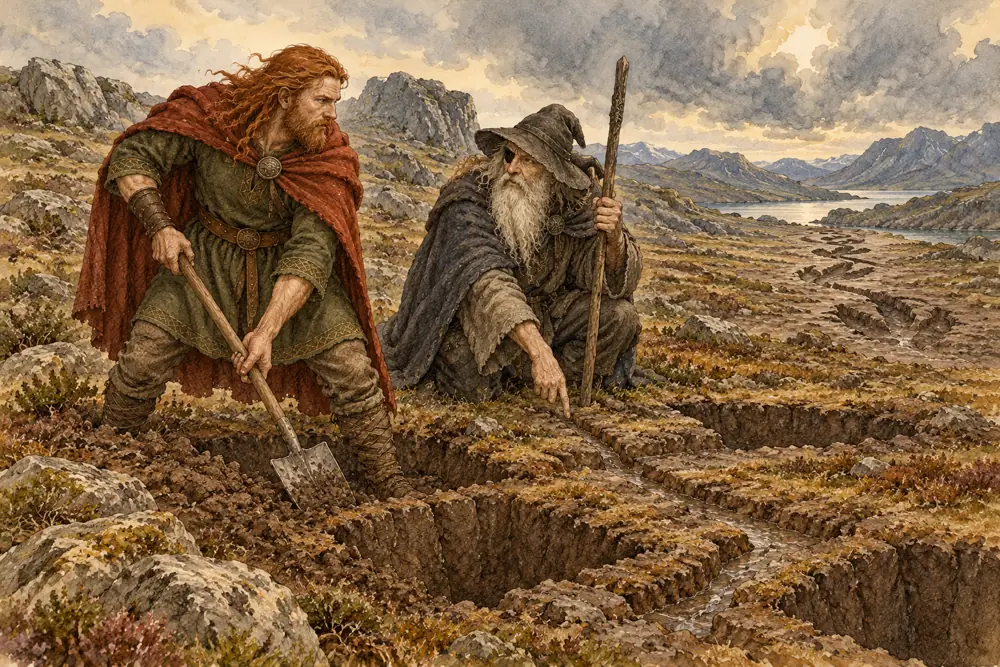
After avenging his father, Sigurd prepares to confront Fafnir, the dragon guarding the treasure described by Regin. When the two approach the track used by the creature on its way to water, Sigurd notices how enormous it is. Regin had minimized the danger while urging him toward the undertaking. The sight of the ground contradicts that reassurance. The young man is courageous, but the story allows him to ask practical questions rather than treating unquestioning obedience as the only possible form of heroism.
The first plan has a weakness
Regin advises Sigurd to dig a pit beneath the dragon’s path, hide inside it and thrust upward into Fafnir’s heart as the creature passes. Sigurd asks what will happen when the blood pours down upon him. Instead of answering, Regin challenges his courage and compares him unfavorably with his ancestors. Then Regin leaves. This exchange matters because the objection is not unreasonable: the proposed hiding place could also become a trap. The narrative separates useful tactical information from the pressure exerted by a teacher who has interests of his own.
Another adviser, another kind of help
While Sigurd is digging, an old man with a long beard appears and asks what he is doing. Hearing the plan, he recommends making several pits so that the blood can run away rather than collecting around the fighter. Sigurd should occupy one of them and strike from there. The man disappears after giving this advice. Readers commonly identify him as Odin because he repeats the pattern of the mysterious helper elsewhere in Sigurd’s life. The passage itself does not introduce him by name, so that identification should remain explicitly distinguished from the actions the saga actually narrates.
The blow and the conversation afterward
Sigurd follows the revised plan. When Fafnir crawls overhead, shaking the ground and breathing venom, he thrusts the sword into the creature’s body and escapes from the pit. The dying dragon then speaks with him. Their exchange turns from the mechanics of killing to identity, fear and the danger of possessing the treasure. The warning prevents the victory from becoming a clean ending: the hoard carries a history that physical bravery cannot erase. This episode belongs primarily to Völsunga saga’s prose narration. The related Eddic poem Fáfnismál preserves the conversation and its framing differently and should not automatically be credited with every detail of the old man’s intervention. The scene rewards attention as well as daring. Sigurd succeeds not because his question about the blood was shameful, but because someone finally answers it.
Read behind the retelling
Sources & limits
The long-bearded helper is conventionally interpreted as Odin but is not named in this particular scene. Follow Völsunga saga for the extra pits; do not silently attribute all its prose details to Fáfnismál.
- Völsunga saga, chapter 18 — Morris and Magnússon translation
- Fáfnismál, prose frame and poem — Bellows translation, 1923
Retold in contemporary English. Dialogue is summarized, not presented as a translation. How to read our sources and versions.
Another thread to follow

2 min read
Thor and the stone-hearted Hrungnir
Hrungnir pursues Odin into Asgard, boasts beyond hospitality, and challenges Thor to meet him armed.
Read the story ↗
2 min read
Thor and the ferryman
Thor needs a ferry. Hárbarðr offers insults instead, and a verbal contest replaces the expected passage.
Read the story ↗
2 min read
The mead of poetry
The blood of Kvasir passes through murder, bargaining and deception before the poetic mead reaches the gods.
Read the story ↗