
A Norse story · 2 min read
Odin’s eye at Mimir’s well
The price of a drink of wisdom
Even Odin cannot simply command the knowledge held beneath the world-tree.
A source beneath the roots
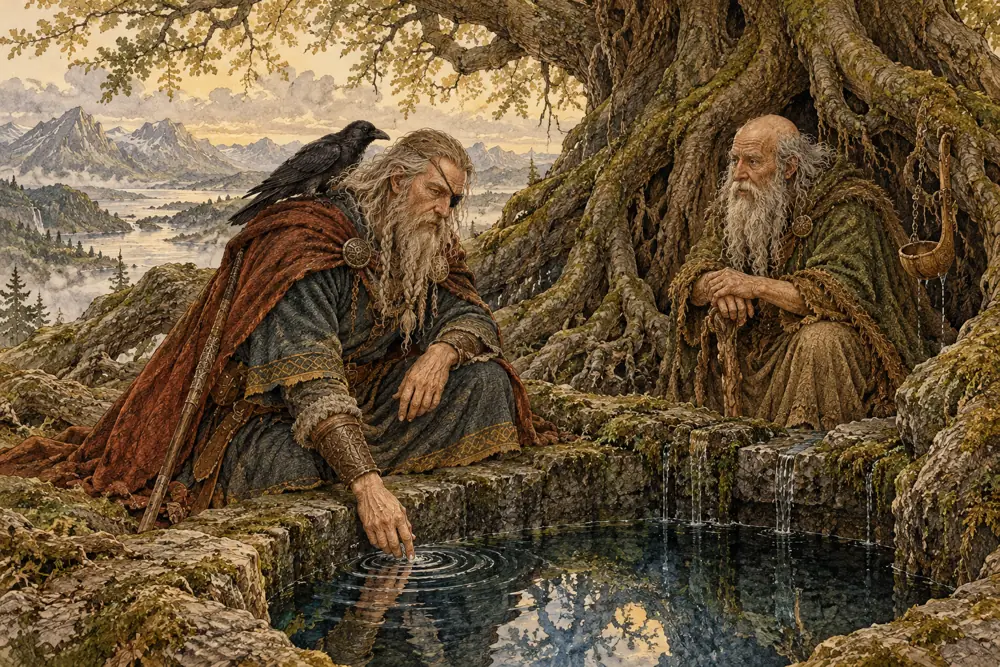
In Gylfaginning, the great ash Yggdrasil reaches across the world and is supported by enormous roots. Beneath the root extending toward the frost-giants lies Mimir’s well. Wisdom and understanding belong to its water, and Mimir, its keeper, possesses deep knowledge because he drinks from it. The setting makes knowledge something older and deeper than the political authority of the gods: Odin must travel to its guardian rather than produce it by issuing a command.
The pledge
Odin asks for a drink. Mimir does not grant it without payment, and Odin leaves an eye as a pledge. The surviving prose is brief. It does not describe a long negotiation, a weapon used to remove the eye or a succession of visions when he drinks. Those details can make a modern story dramatic, but they should not be attributed to this source. What it securely gives us is a chosen loss in return for access to wisdom.
The seer knows his secret
Völuspá also associates Odin’s hidden eye with Mimir’s well. The seer’s knowledge of the pledge forms part of her address to him: the god who seeks secret knowledge is himself known and exposed. Gylfaginning quotes the poetic passage as support for its explanation. The poem’s condensed imagery and the prose’s explanatory narrative do different work, and translations do not always handle the wording of the pledge in exactly the same way.
Wisdom does not cancel danger
Later in Gylfaginning, as the final crisis approaches, Odin again seeks Mimir’s counsel. Having paid for knowledge does not place him outside fate. This is one reason the eye story remains powerful: wisdom has a cost but is not a guarantee of victory. It is also distinct from the tale in which Odin preserves Mimir’s severed head after a hostage exchange. The sources offer both traditions without giving a complete account of their relationship. We can recognise the repeated dependence on Mimir while leaving the missing connections open.
Read behind the retelling
Sources & limits
The source does not specify which eye Odin gives. Detailed removal scenes and a fixed chronology linking well and severed head are later reconstructions.
Retold in contemporary English. Dialogue is summarized, not presented as a translation. How to read our sources and versions.
Another thread to follow

3 min read
Ragnarok: the breaking of the world
The end approaches through broken human bonds and broken cosmic restraints. The surviving texts also imagine a world that rises after the disaster.
Read the story ↗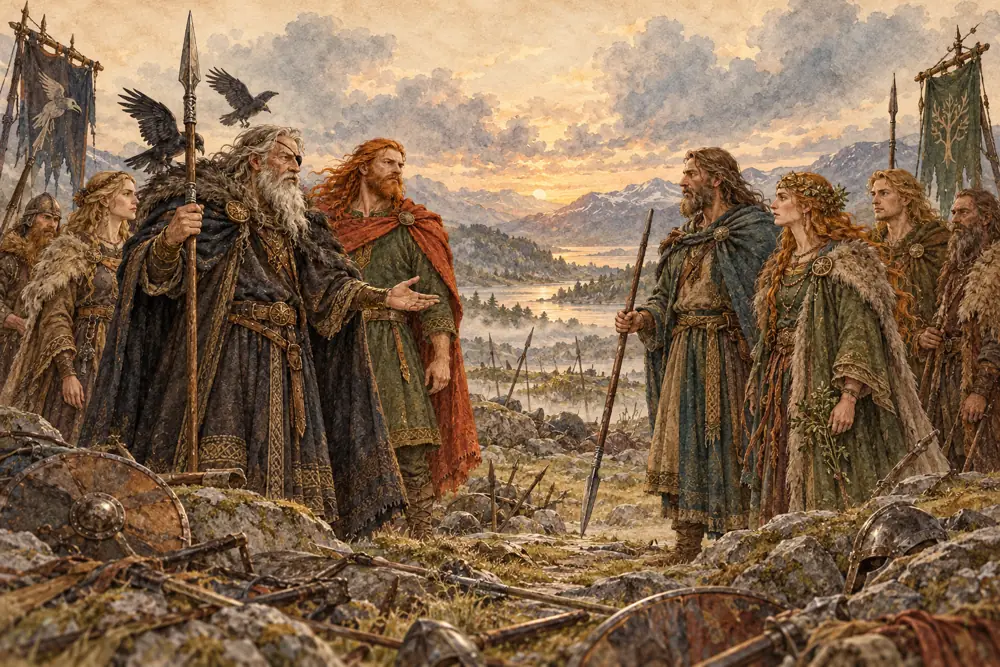
2 min read
The war between the Æsir and Vanir
An early war, a mysterious woman and an uneasy peace survive in accounts that do not fit together neatly.
Read the story ↗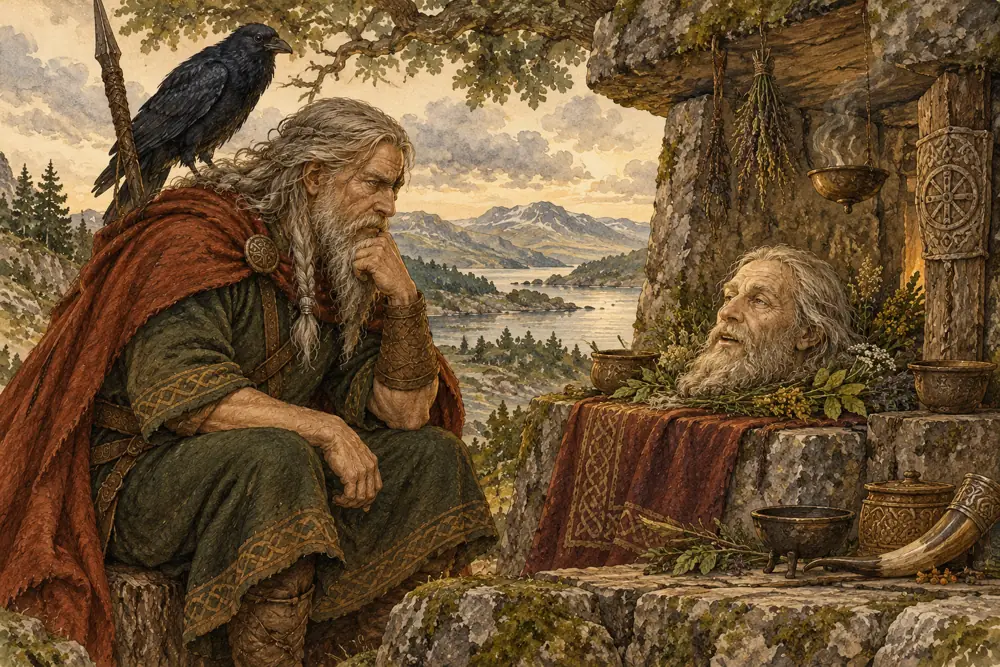
2 min read
Mimir’s speaking head
A hostage exchange ends in murder, but Odin preserves the counsellor whose advice remains indispensable.
Read the story ↗