
A Norse story · 2 min read
Odin’s ordeal for the runes
Nine nights on a wind-beaten tree.
Hávamál gives Odin a brief, disturbing account of sacrifice, deprivation and the gaining of runes.
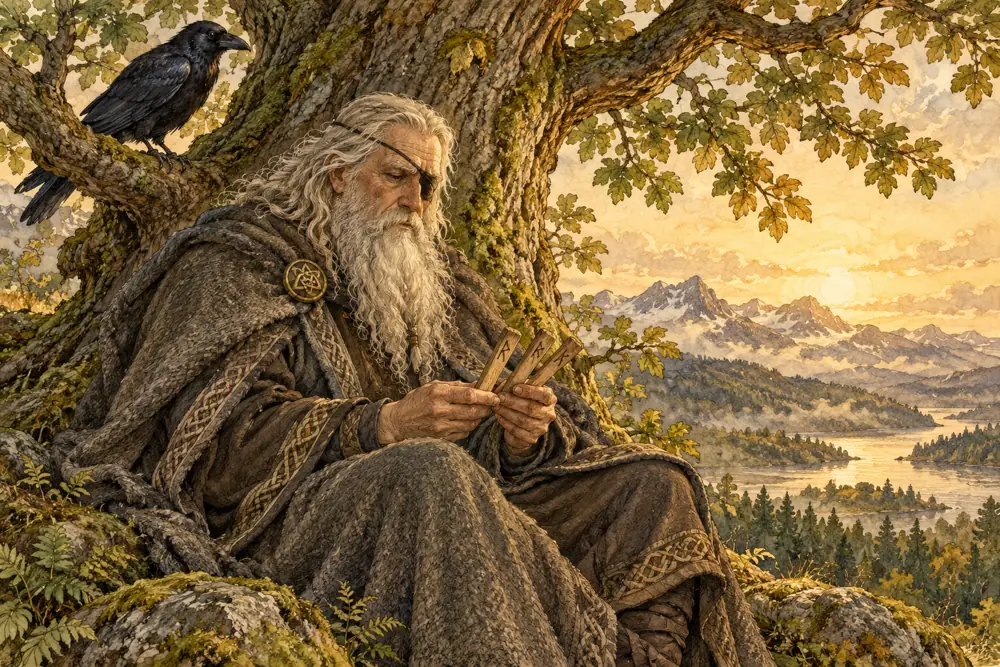
An account in Odin’s own voice
Near the end of Hávamál, the speaker recalls hanging for nine nights on a wind-beaten tree. He is wounded by a spear and dedicated to Odin: himself offered to himself. The passage is short and intense. It does not supply a long explanation of how the ordeal was arranged, name witnesses standing below, or describe a sequence of adventures leading up to it. Many modern retellings add such scenery. Here it is better to preserve the starkness of what the poem actually gives us: the god seeking knowledge is also the sufferer and the recipient of the sacrifice.
Looking downward
No one gives him bread or drink. He looks down, takes up the runes with a cry, and falls back from the tree. Following verses speak of powerful songs, a drink of precious mead, and the growth of understanding. Words lead to words and deeds to deeds. The passage does not resemble the discovery of an alphabet in an archaeological sense. It presents knowledge of runes within a mythic account of costly acquisition and increasing power. Historical runic writing and this poetic origin story are related topics, but they answer different kinds of questions.
What tree is it?
The hanging tree is commonly identified with Yggdrasil, the great tree of Norse cosmology. That identification is traditional and meaningful, but the verses describing the ordeal do not explicitly call the tree Yggdrasil. They emphasise instead the mystery of its roots. We therefore describe it as the wind-beaten tree and explain the usual identification separately. Likewise, the poem does not tell us that Odin sacrificed his eye during these nine nights. The eye and Mímir’s well belong to another account. Combining them into a single scene would produce a familiar modern story at the expense of the surviving evidence.
Reading the mystery without solving it away
The ordeal can be read as a myth of initiation, sacrifice or the painful gaining of insight. These are interpretations, not a set of instructions the poem gives for reconstructing a universal Viking ritual. The surviving text leaves important questions open, including how adjacent passages were brought together. Stanza numbering also varies between editions: the familiar hanging verse is often numbered 138, but Bellows’s rearrangement places it at 139. Anyone comparing translations should locate the words and surrounding passage rather than assume identical numbers. The central image remains clear even when its full background does not: Odin’s knowledge is something he suffers to obtain.
Read behind the retelling
Sources & limits
The tree is not named Yggdrasil in the hanging verses. The eye at Mímir’s well is a separate episode. This myth is not a practical ritual guide.
Retold in contemporary English. Dialogue is summarized, not presented as a translation. How to read our sources and versions.
Another thread to follow
2 min read
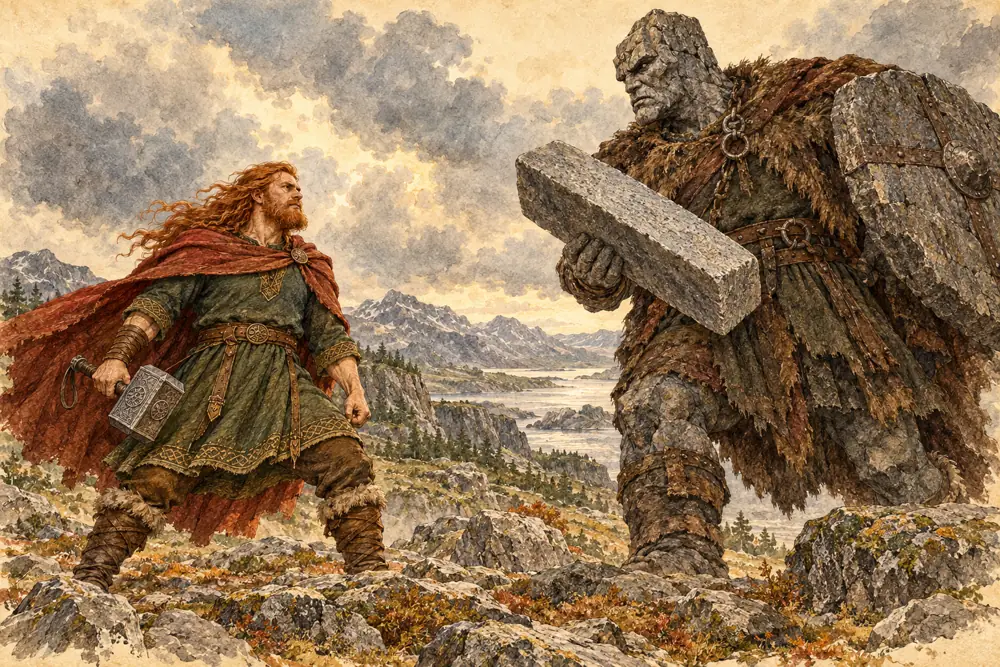
Thor and the stone-hearted Hrungnir
Hrungnir pursues Odin into Asgard, boasts beyond hospitality, and challenges Thor to meet him armed.
Read the story ↗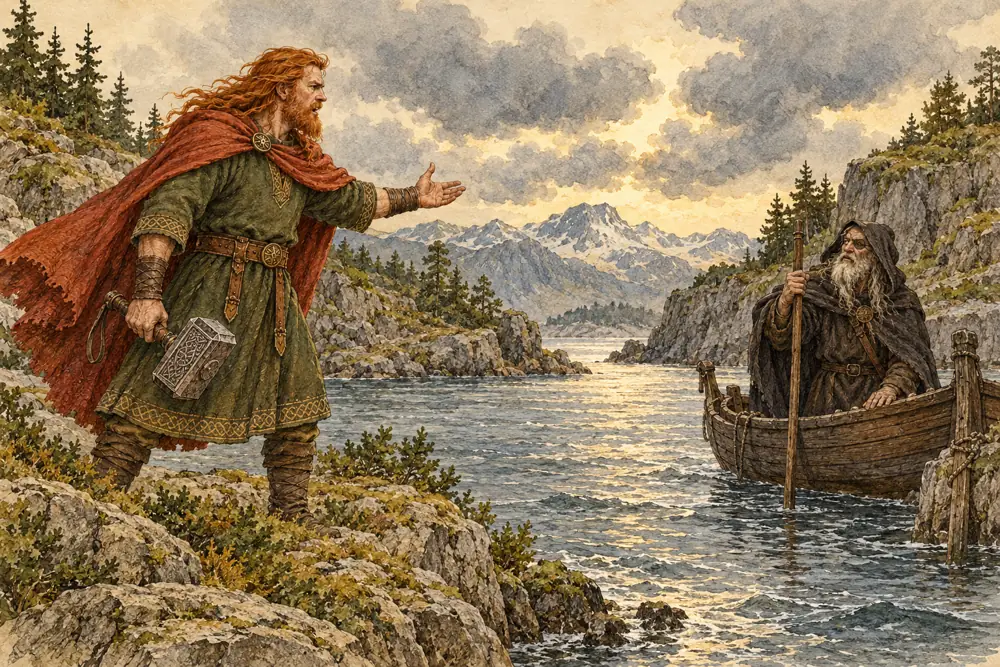
2 min read
Thor and the ferryman
Thor needs a ferry. Hárbarðr offers insults instead, and a verbal contest replaces the expected passage.
Read the story ↗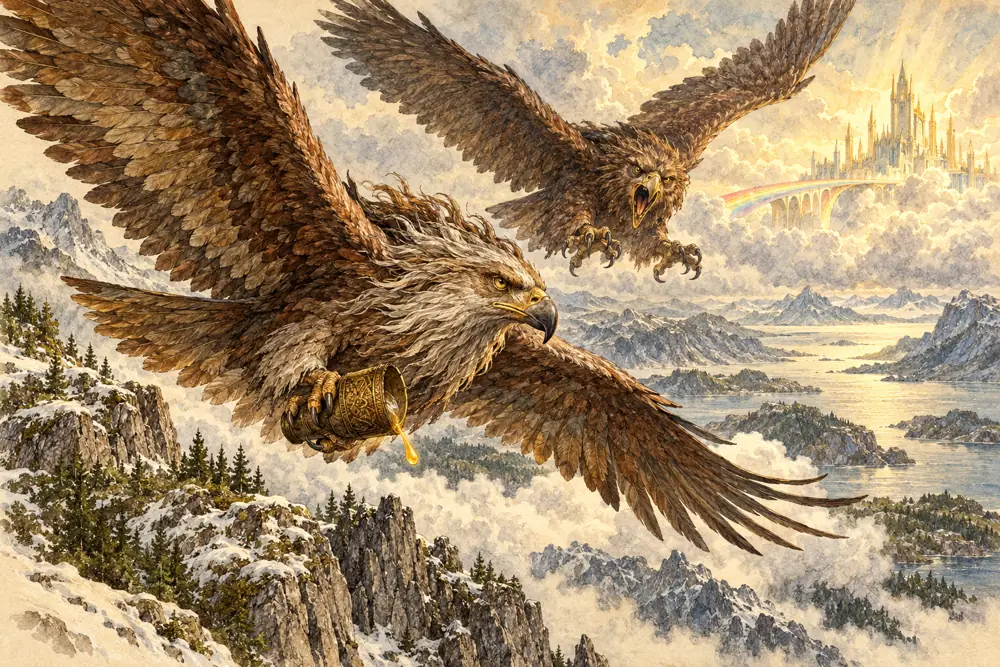
2 min read
The mead of poetry
The blood of Kvasir passes through murder, bargaining and deception before the poetic mead reaches the gods.
Read the story ↗