
A Norse story · 2 min read
Sinfjotli and the vanishing boatman
A grieving father carries his son to a shore where explanation ends.
After Sinfjotli dies from poisoned drink, Sigmund encounters a stranger with a small boat. The stranger takes the body and vanishes; he is commonly interpreted as Odin, though the scene does not name him.

A death inside the household
Sinfjotli has killed the brother of Borghild, Sigmund’s wife, in a dispute involving their pursuit of the same woman. Borghild wants the killer expelled, but Sigmund refuses to send his son away and offers compensation instead. Outwardly she accepts the arrangement and prepares the funeral feast. The apparent settlement does not end her determination to avenge her brother. The danger therefore enters through a ceremony meant to acknowledge a death and restore relationships, not through an openly declared battle against an enemy outside the household.
The third cup
Borghild brings Sinfjotli a horn of drink. He suspects poison and refuses it, so Sigmund drinks in his place. The pattern happens again, with Borghild taunting her stepson for relying on another man to drink for him. At the third offering, Sinfjotli again recognizes danger, but Sigmund, now drunk, tells him to strain the drink through his lips. Sinfjotli drinks and dies. The Eddic prose explains the difference in their vulnerability: Sigmund could withstand poison internally, while his son did not share that protection. Their family resemblance therefore conceals a fatal difference.
The small boat at the shore
Sigmund lifts the body and carries it away in grief until he reaches a fjord. There he meets a man in a little boat who offers passage. The vessel cannot hold everyone at once, so the body is put aboard first while Sigmund remains ashore. The boat and its occupant disappear. Nothing in the scene supplies a visible arrival at Valhalla, a speech from the dead man or a reunion with other warriors. Those additions may seem natural to a modern storyteller, but they would fill a deliberate silence in the surviving account.
Recognizing Odin without inventing an ending
The mysterious ferryman is commonly understood as Odin, and the older translation’s note makes that identification. The narrative itself does not name him at the shore. A careful retelling can explain the interpretation while preserving that distinction. The action also complicates the idea that every Odinic hero must die in battle: Sinfjotli has been poisoned during a feast. Sigmund returns home and drives Borghild away, but the supernatural encounter does not undo his loss. The father who could drink the poison safely could not protect his son from it, and the stranger takes the body beyond his reach. This combination of domestic vengeance, unequal protections and unexplained disappearance gives the episode its unsettling character. Its boat is part of a legend, not documentation of a particular funeral vessel or an instruction for a universally practiced burial rite.
Read behind the retelling
Sources & limits
The boatman is unnamed in the story and identified as Odin by interpretation. Neither the saga scene nor the Eddic prose gives a narrated arrival at Valhalla; do not invent one.
- Völsunga saga, chapter 10 — Morris and Magnússon translation
- Frá dauða Sinfjötla — Bellows translation, 1923
Retold in contemporary English. Dialogue is summarized, not presented as a translation. How to read our sources and versions.
Another thread to follow

2 min read
Thor and the stone-hearted Hrungnir
Hrungnir pursues Odin into Asgard, boasts beyond hospitality, and challenges Thor to meet him armed.
Read the story ↗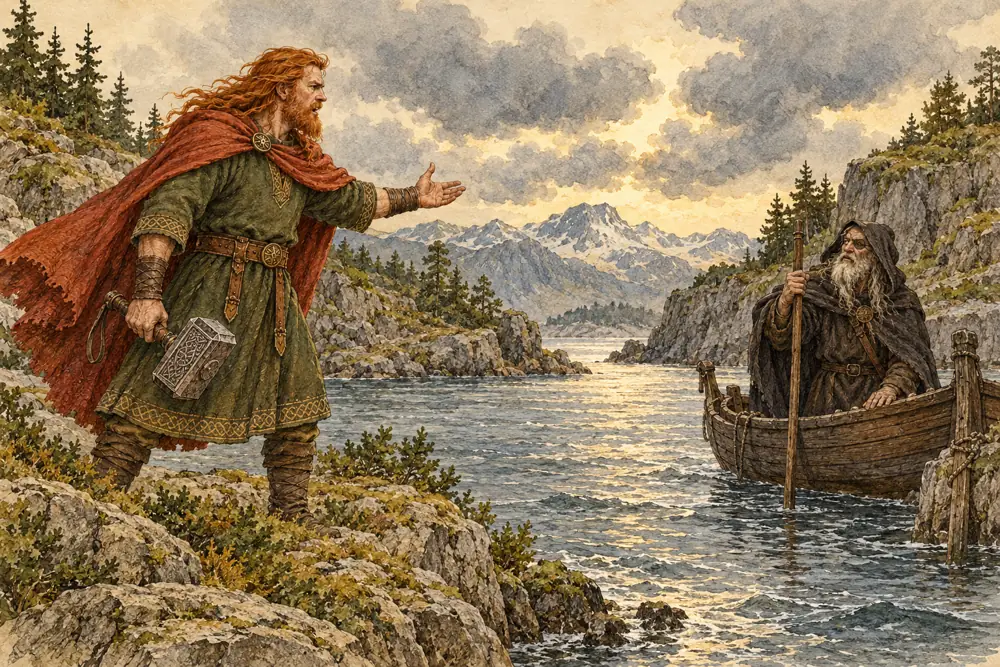
2 min read
Thor and the ferryman
Thor needs a ferry. Hárbarðr offers insults instead, and a verbal contest replaces the expected passage.
Read the story ↗
2 min read
The mead of poetry
The blood of Kvasir passes through murder, bargaining and deception before the poetic mead reaches the gods.
Read the story ↗