
Viking crafts · An illustrated deep exploration
Bronze &
silver casting.
From model
to metal.
Look inside the mould. Follow a design from wax to metal, and discover what broken workshop finds reveal about a skilled craft.
01 · Bronze & silver casting
Start with the workshop, not the treasure.
A finished brooch shows what someone wore. Workshop waste can show where and how similar objects were made. Mould fragments preserve designs in reverse; crucible fragments record contact with heated metal. An unfinished casting can retain traces that a finished surface has lost.
Birka · excavated evidence
Thousands of fragments
Excavations in Svarta Jorden in 1990–95 recovered about 25,000 mould fragments and almost 10,000 crucible fragments. These are counts of broken pieces, not complete vessels or finished products. [1]
Birka · first half of the ninth century
Repeated brooch production
Moulds attest to substantial oval-brooch manufacture, alongside other products. The assemblage links making to a particular place and period; an ornament found far away cannot establish its workshop by itself. [1]
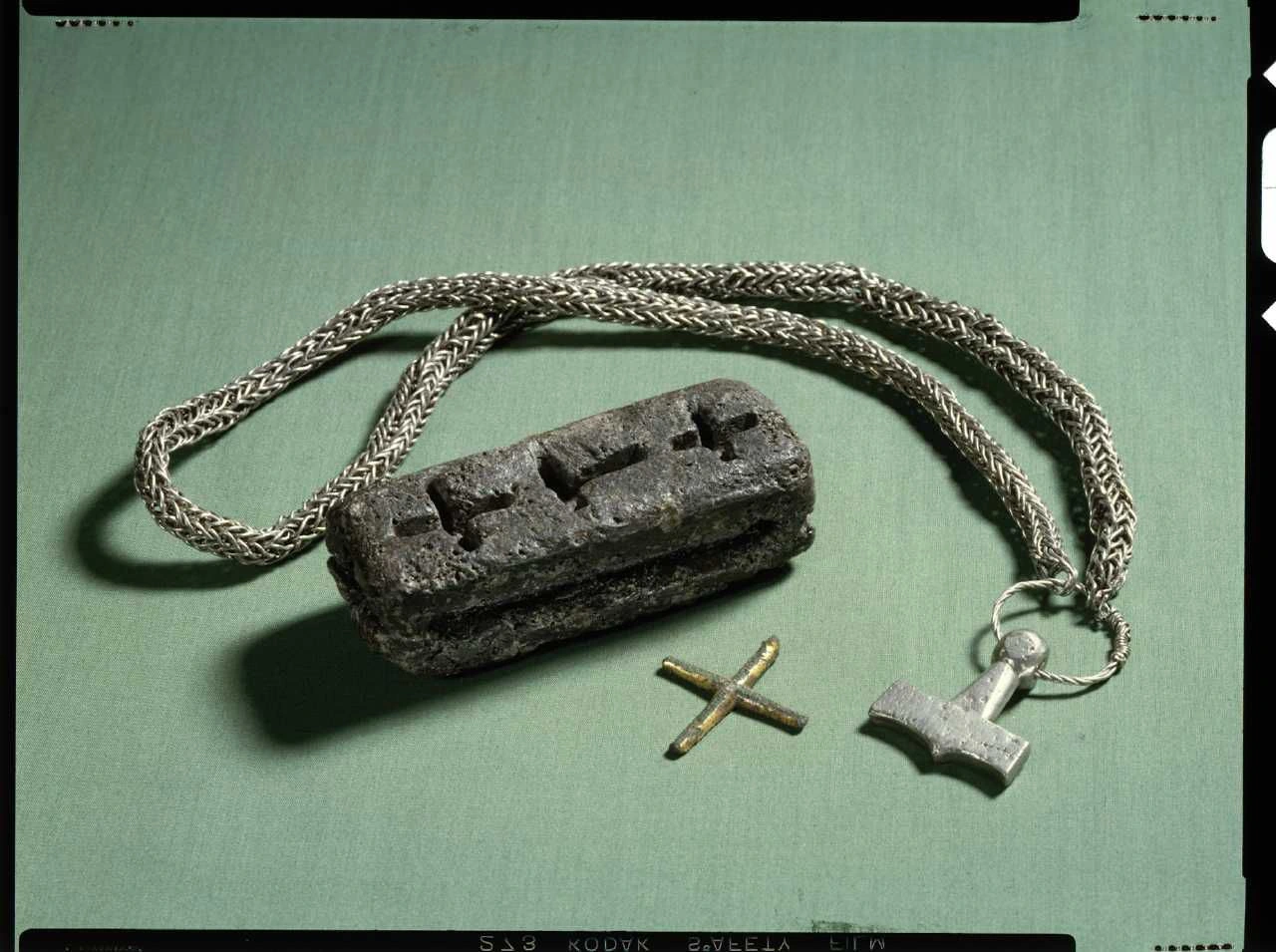
How to read this study: excavated objects, analytical results and modern experiments answer different questions. The modern illustrations explain relationships; they are not photographs or exact reproductions of individual finds. The separately credited museum photograph shows real archaeological objects.
02 · Bronze & silver casting
“Bronze” needs a closer look.
Copper alloy is the useful broad term when composition is uncertain. Bronze, brass and gunmetal describe different mixtures. Historic material may contain additional elements, including lead; an object’s modern surface colour is not a compositional analysis. [1]
| Material | Main constituents | What to remember |
|---|---|---|
| Bronze | Copper + tin | A particular copper alloy. |
| Brass | Copper + zinc | Common in the analysed Ribe material. |
| Gunmetal | Copper + tin + zinc | A mixed copper alloy. |
| Silver | Silver, with variable other elements | Purity needs evidence; “silver” does not mean chemically pure. |
Orfanou and colleagues examined Ribe crucibles, moulds, ingots and objects from the eighth and ninth centuries. Brass, including leaded brass, predominated, with smaller-scale silver and gold working. Alloy choices became more consistent towards the early ninth century. This is a result for that assemblage, not a universal recipe for Viking jewellery. [3]
03 · Bronze & silver casting
The container, the cavity and the object.
Keep these three things separate when looking at workshop finds. A broken cup and a fragment with an ornament in reverse need different questions. Where is the inner surface? Is there a design impression? Does metal remain attached? What else was found beside it?
At Ribe, researchers compared several kinds of production debris rather than treating each category in isolation. This is why a modest ceramic fragment can be more informative about manufacturing than a polished ornament. [3]
The diagrams describe historical principles. They are not equipment designs or instructions for handling molten metal.
04 · Bronze & silver casting
A mould’s shape and its making are different questions.
Birka preserves stone moulds and abundant sandy clay moulds. Open cavities suited simple bars. [2]
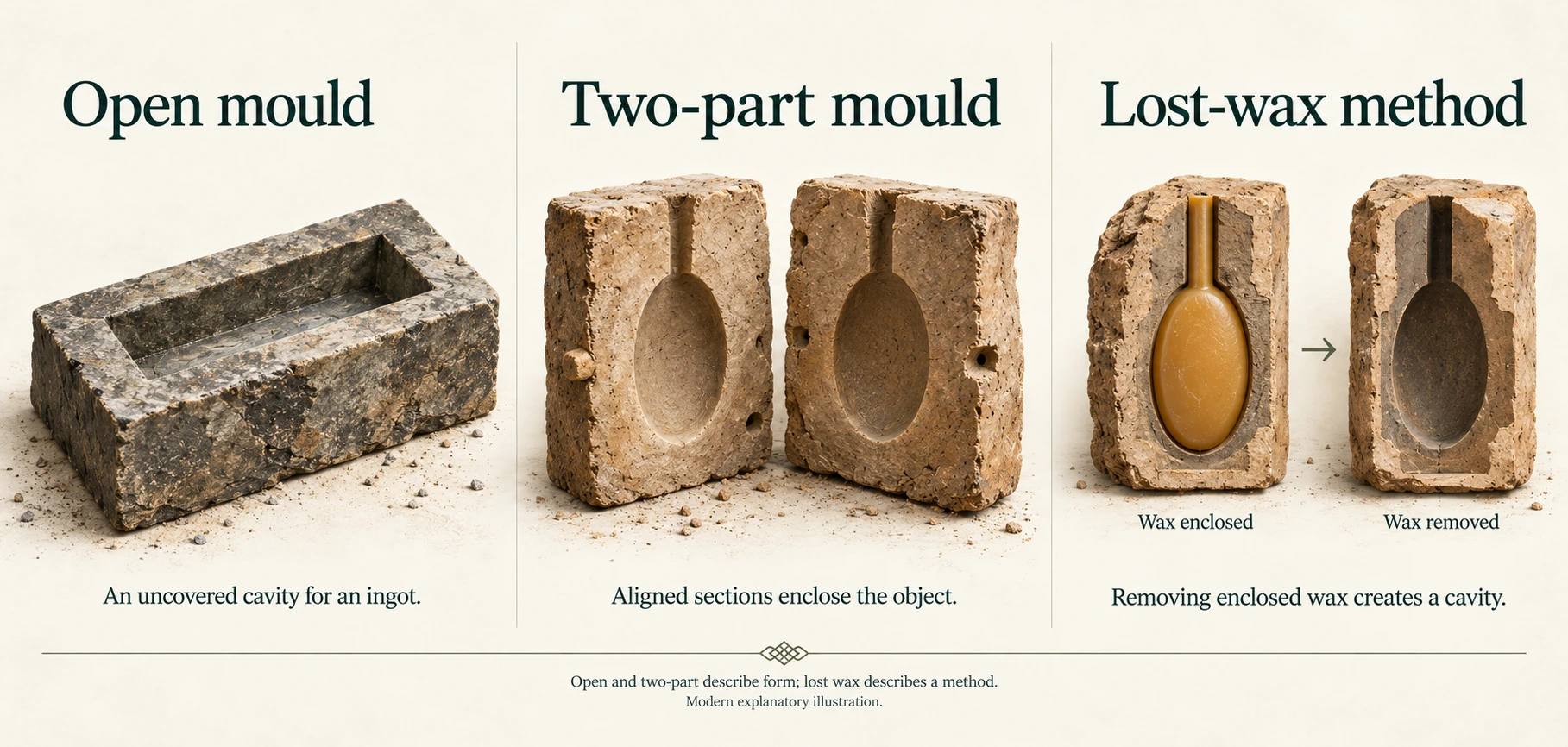
Open mould
An uncovered cavity for an ingot.
Two-part mould
Aligned sections enclose the object.
Lost-wax method
Removing enclosed wax creates a cavity.
These are not three exclusive boxes. “Open” and “two-part” describe form. “Lost wax” describes how a cavity was created. Birka’s oval-brooch moulds have been reconstructed with a combination of two-part construction and lost-wax work. [2]
05 · Bronze & silver casting
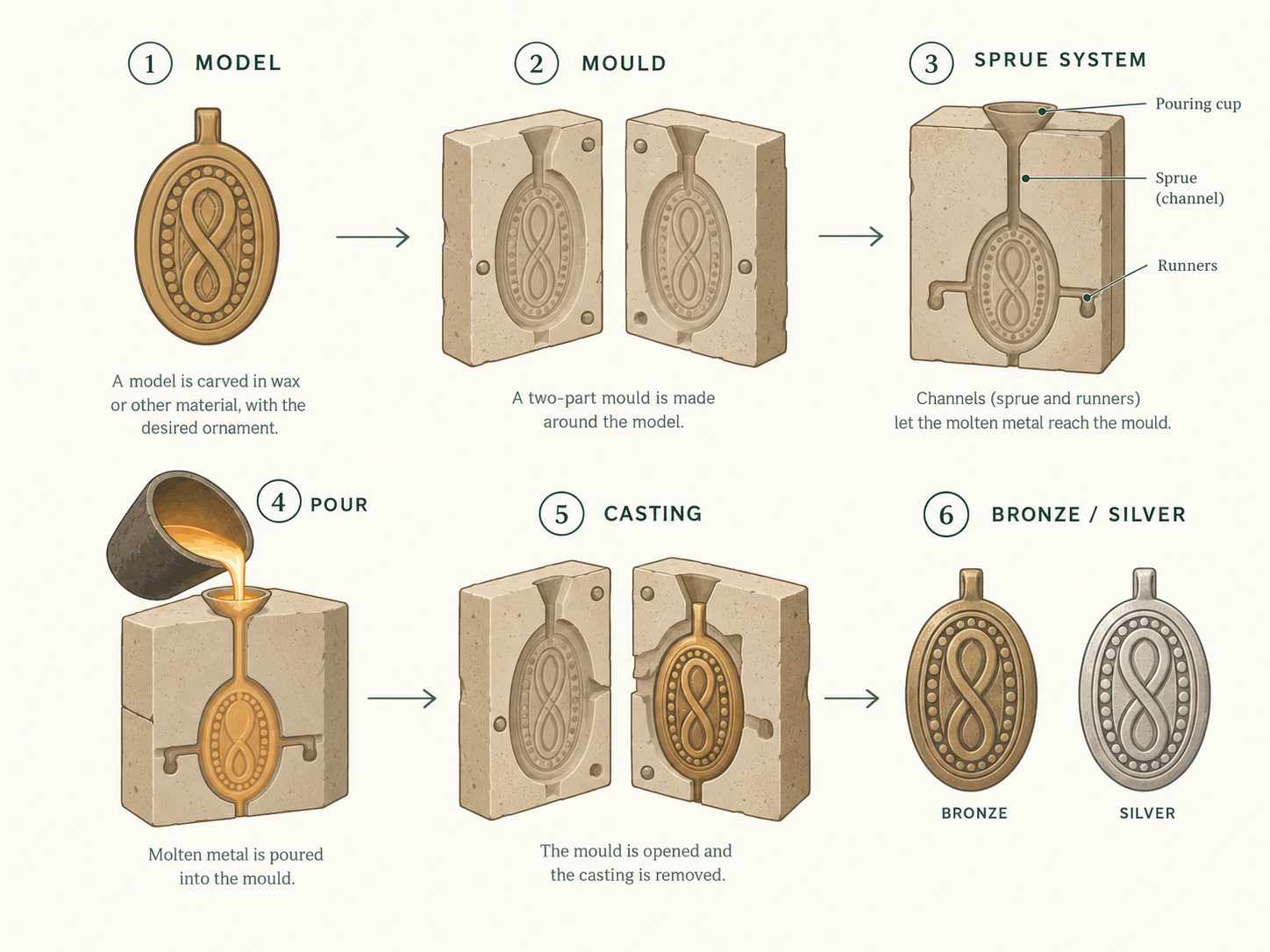
Follow the shape from wax to metal.
Select a stage to follow the model, cavity and casting. [2]
1 · Wax occupies the future casting’s shape.
- Model. Wax represents the intended object.
- Enclose. Clay surrounds it, with a route into the interior.
- Remove the wax. Its former position becomes a cavity.
- Cast. Metal occupies the cavity and solidifies.
- Release. Opening or breaking the mould reveals an object that still needs finishing.
06 · Bronze & silver casting
A lost model does not mean a lost design.
A durable master and a disposable wax copy serve different purposes. At Tissø, bronze and lead models survive alongside unfinished objects, failed castings and scrap. Such finds connect design, production and reuse. They should not all be called “moulds.” [5]
Söderberg’s experiments show how repeated wax copies can carry one design into many disposable moulds. His work also demonstrates that clay built around wax can split along a join and resemble a two-part mould. The fracture alone does not settle the method. [4]
A useful distinction
Master → copy → casting
Ask which item could be retained and which was consumed. A reusable master can outlive many wax copies.
A surface worth studying
Textile patterns on brooch backs
Positive textile patterns have informed experiments with modelling. A workable reconstruction explains one possible route; it does not prove that every brooch followed it. [4]
07 · Bronze & silver casting
Silver could become a resource before it became an ornament.
An ingot is a useful intermediate form. It can store metal for later work or circulate as bullion. Kruse, Smith and Starling compared experimentally cast silver bars with Viking-Age examples, examining surface textures, depressions, textile patterns and later subdivision. [6]
What the experiments tested
Stone, fired-clay and sand moulds produced different traces, sometimes overlapping. Soapstone moulds could be reused. Cloth textures could be transferred through a mould’s surface.
What they did not reproduce
The researchers used modern equipment and crucibles that were not exact Viking copies. Wear and corrosion can blur distinctions on archaeological ingots. A matching mark supports an interpretation; it need not uniquely identify a technique.
Evidence concerning plain silver ingots should not automatically be applied to elaborate jewellery. Different products can involve different mould materials and production choices. [6]
08 · Bronze & silver casting
Casting was a beginning, not always the finish.
A pouring channel can leave an attached projection called a sprue. Other unwanted metal may need removal, while surfaces and decoration require attention. Ribe VikingeCenter’s modern demonstrations illustrate sawing, filing and polishing after casting. Their working time is not a measured Viking production rate. [8]
Haithabu · an unusually revealing find
Nine objects with a question attached
Coin-like objects from the 1980 harbour excavation retained casting projections. Analysis identified tin–lead alloy, despite their resemblance to silver dirhams. They copy a coin design dated 807/808; this does not date the casting itself. The museum leaves their purpose open: counterfeits or intended pendant blanks. They demonstrate casting traces, not silver casting. [7]
A finished ornament may combine cast elements with later shaping, joining and decoration. Examine a specific object before deciding which details came from its mould.
09 · Bronze & silver casting
The caster worked with other crafts.
Not every mould made jewellery. Croix, Neiß and Sindbæk used three-dimensional scans to identify eighth-century Ribe mould fragments for metal components associated with wooden chests, belts and horse harnesses. These connect the caster’s work to objects made with wood and leather. [12]
The authors interpret collaboration between crafts as part of the development of urban workshops. The identified impressions and the wider social explanation are different levels of argument: a fitting is tangible evidence; reconstructing the organisation around it requires comparison and interpretation.
A market town
Ribe’s production can be followed through workshop deposits and analytical samples. Its early material includes the eighth century, before the conventional beginning of the Viking Age.
An elite residence
Tissø’s makers supplied household use, gifts and trade. Its museum page includes sixth- to eighth-century jewellery as well as Viking-Age models; those groups should retain their separate dates. [5]
Continue with woodworking and housebuilding to see another part of this material world.
10 · Bronze & silver casting
New metal and recycled metal shared the same world.
Recycling is only part of the supply story. Merkel analysed 25 copper-alloy bars from Hedeby’s harbour, attributed to the early ninth century by their type and location. The study identified consistent, freshly produced brass. Suggested Balkan or Andalusian sources remain possibilities, not a securely identified workshop or mine. [11]
Silver could move between coins, ornaments, ingots and new cast forms. Kershaw and Merkel combine lead isotopes and trace elements to investigate this recycling. Mixing makes provenance difficult without necessarily erasing every signal. A metal’s supply history and the place where an object was made are separate questions. [10]
Galloway Hoard · around AD 900
Follow the region as well as the material
National Museums Scotland identifies recycled good-quality silver, mainly coins, in the broad-band arm-rings and ingots. Comparable arm-rings date to about 880–930 and belong to the Irish Sea world, probably largely Ireland. This is evidence for a connected Viking-Age economy, not proof that these ornaments were made in Scandinavia. [9]
11 · Bronze & silver casting
Ask what each trace can actually establish.
Can a crucible residue reveal the exact alloy?
Not directly. The Ribe study shows that elements behave differently during use: zinc can enter the ceramic disproportionately. Residues can identify kinds of metalworking without reproducing the original alloy percentages. Compare ceramics with actual metal samples. [3]
Does a two-part mould rule out lost wax?
No. Söderberg tested ways in which working around wax leaves a divided mould. A joint must be interpreted with surface detail and other traces. [4]
Does a successful replica prove the original method?
It demonstrates that a proposed sequence can work under the recorded conditions. Stronger historical interpretation also needs a match with surviving objects, workshop finds and context.
Try reading a negative shape
For a cold classroom exercise, press a simple textured object into soft modelling clay, then lift it out. Draw the original and its impression side by side. Label raised and recessed areas. This modern exercise explores shape transfer; it does not reproduce a historical casting mould.
12 · Bronze & silver casting
Sources & further reading.
Sources checked 21 October 2026. Museum records, original research and experiments are identified separately below. Numbered references connect claims to their evidence.
- Swedish History Museum: Birka’s foundry and metalworking.Workshop assemblage, fragment counts, ninth-century brooch production and alloy terminology.
- Swedish History Museum: Casting moulds at Birka.Surviving mould materials and forms; interpretation of complex oval-brooch manufacture.
- Orfanou et al. (2021), On diverse arts.Original analytical study of Ribe’s eighth- and ninth-century metalworking; full text. DOI: 10.1007/s12520-021-01308-1.
- Söderberg (2018), Viking Jewellery Mould Making.Experimental and reconstructive research; full text. Explains repeated designs and the limits of identifying methods from mould shape.
- National Museum of Denmark: Trade and crafts at Tissø.Production debris, metal models and different markets. Individual illustrated groups have different dates.
- Kruse, Smith & Starling (1988), Experimental casting of silver ingots.Historical Metallurgy 22(2), 87–92; full paper, PDF. Experimental comparison, using modern equipment.
- Wikinger Museum Haithabu: Geldfälscher in Haithabu?Nine cast tin–lead coin-like objects, their sprue remnants and unresolved purpose.
- Ribe VikingeCenter: Bronzestøberen.Modern craft demonstration; used here to explain finishing, not to establish an exact Viking working time.
- National Museums Scotland: How “Viking” is the Galloway Hoard?Recycled silver and the Irish Sea context of the broad-band arm-rings.
- Kershaw & Merkel (2022; online 2021), Silver recycling in the Viking Age.Original isotopic and trace-element research. DOI: 10.1111/arcm.12709.
- Merkel (2018), Archaeometallurgical investigations of a Viking brass ingot hoard from the Hedeby Harbor.University record and abstract consulted. Journal of Archaeological Science: Reports 20, 293–302. DOI: 10.1016/j.jasrep.2018.04.019.
- Croix, Neiß & Sindbæk (2019), The réseau opératoire of Urbanization.Publisher’s abstract consulted. Ribe workshop moulds and collaboration between crafts. DOI: 10.1017/S0959774318000525.