
Viking crafts · Wood, fibre & iron
Longbows & Arrows: Wood, Feathers and the Evidence
Explore Viking-Age bow and arrow crafts through Hedeby timber, Lauvhøe feathers and the remarkable evidence preserved in Norway’s mountain ice.
Explore the craft ↓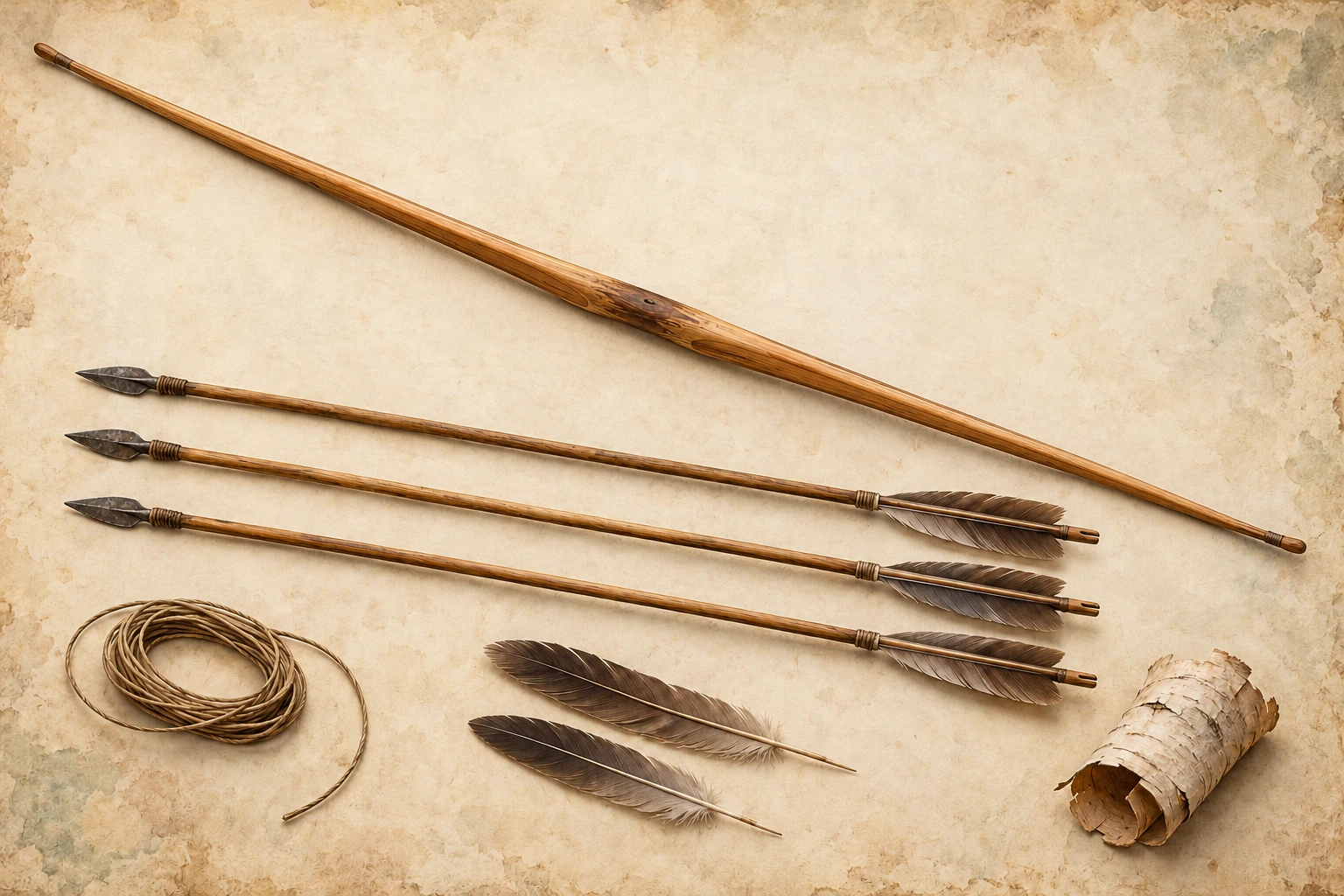
01 · Longbows & arrows
One piece of wood, many kinds of skill
A wooden bow can look deceptively simple beside a decorated sword. Its interest lies in less conspicuous things: the character of the timber, the relationship between its parts and the knowledge needed to turn natural materials into a dependable object. A self bow has its principal body made from one piece of wood. The term describes construction, not a single historical shape or a particular people's invention. Museum Nord distinguishes this from composite bows assembled from several materials. [10]
For this study, the bow belongs beside the arrow and the string. Together they connect woodworking, ironworking and work with animal and plant materials. Looking at the whole assemblage brings those quieter crafts into view, even when only a metal point survives in a display case.
02 · Longbows & arrows
Hedeby: a starting point, not a universal pattern
Hedeby, also called Haithabu, supplies an important starting point for Viking-Age wooden bows. The Viking Ship Museum identifies a particularly well-preserved yew example and also records elm bows from the settlement. Both woods therefore belong in the story. Treating yew as the only historically acceptable material would erase part of the evidence. [8]
Hedeby's museum also draws attention to distinctive curved bow tips. That is a useful reminder that an actual find can carry features absent from a generic illustration. [9] The unstrung bow shown on this page introduces the subject visually; it is not presented as a measured copy of that particular artefact. A reconstruction of a named find would require a much closer comparison with its surviving form and documentation.
03 · Longbows & arrows
Reading the timber
Wood identification gives an archaeological object a history more specific than its brown surface suggests. At Langfonne in Norway, the published dating table identifies birch in numerous arrow samples, including samples whose date ranges overlap the Viking Age. Other woods appear elsewhere in the site's much longer sequence. The table records individual objects and samples, allowing materials to be compared with chronology instead of being gathered into one timeless list of “Viking woods.” [1]
This distinction matters when reading a workshop scene. A bow and an arrow need not share a wood species, even when they lie on the same bench. Naming the material is also different from identifying its origin: a species determination alone does not tell us which woodland supplied it or who obtained it. Those are further research questions.
04 · Longbows & arrows
The bowstring: a small object with a large gap
In its account of the Hedeby bow, the Viking Ship Museum suggests flax as a probable string material. That is an interpretation, not a claim that the cited bow retains a string whose fibres have been positively identified. [8]
Organic materials also have different prospects of survival. The Norwegian ice researchers note that textiles and sinew deteriorate more quickly after exposure than wood and bark. The apparent balance of materials in an excavation can therefore be misleading. [5]
For a reader, the useful question is what kind of evidence a pictured cord represents. A caption should distinguish a surviving component from an illustrative addition. The string also provides a natural connection to the wider history of flax processing and cordage: a small detail invites us to consider a much larger world of fibre skills.
05 · Longbows & arrows
An arrow is an assembly of different materials
An arrow makes the meeting of crafts especially visible. Its wooden shaft, point, feathering and surviving attachments can each preserve different information. The metalwork attracts the eye, yet a small patch of organic material may be the more unusual discovery. It can preserve a connection between parts that would otherwise appear as separate museum objects.
Two arrows recovered at Trollsteinhøe in 2013 retained feathering remains; one also retained its iron point and sinew binding. They date to AD 300–600, so they are earlier Iron Age comparisons rather than Viking-Age specimens. [4] They nevertheless show why the historian of craft studies complete relationships, not just attractive components. Calling an arrow an assembly also does not tell us how labour was organised: several material skills need not imply several different makers.
06 · Longbows & arrows
Three feathers from Lauvhøe
At Lauvhøe in 2007, archaeologists recovered an unusually intimate trace of Viking-Age arrow making: three feathers belonging to one arrow. The programme's photograph shows two of them. The associated iron arrowhead retained birch bark around its tang, the projecting part connected with the shaft. These delicate remains move the discussion beyond a bare metal point. [3]
The feathers were recovered among stones rather than displayed in a pristine, fully assembled arrow. Their survival therefore deserves careful description. The account does not identify a bird species or establish an original colour scheme. It also records three arrows from the same ice patch belonging to very different periods: AD 300–600, the Viking Age and the fifteenth century. One location can hold several distinct histories of craft.
07 · Longbows & arrows
Langfonne: six millennia, not one Viking moment
The 2020 investigation of Langfonne, a reindeer-hunting site, reported 68 arrows extending from the Stone Age into the medieval period. Such a collection is valuable because it opens a long view of repeated visits to a mountain landscape. It is not the equipment of one hunting party. The report identifies a concentration of finds in the Late Iron Age, a period it defines as AD 550–1050, broader than the Viking Age alone. [2]
One particularly striking photograph shows a complete arrow lying on the scree near the retreating ice. Its date is around AD 700. That makes it an important neighbouring comparison, but an unsuitable illustration for an unqualified caption saying “a Viking arrow.” Reading the date before borrowing the image preserves the object's own history and makes comparisons between periods more interesting.
08 · Longbows & arrows
Dating the object and dating the wood
Archaeologists approach the age of these objects through both typology and radiocarbon analysis. Typology compares recognisable forms with examples from dated contexts. Radiocarbon analysis examines organic material, but the result concerns the sampled material rather than an exact moment when somebody carried an arrow into the mountains. [6]
The Secrets of the Ice team explains the problem through pine shafts. A piece taken from an older tree ring can produce a date earlier than the object's manufacture or use. Shorter-lived materials can reduce that particular difficulty. This is why a museum date should be read together with the sample description and the stated range. A carefully qualified date is useful evidence; turning it into a precise year of manufacture would create a certainty the analysis does not provide.
09 · Longbows & arrows
What the ice keeps—and what exposure removes
The mountain ice preserves an uneven record. After an object emerges, materials do not all deteriorate at the same rate. The programme notes that wood, birch bark and bone generally withstand exposure better than sinew, hide and textiles. An arrow whose feathers or bindings are now absent may once have possessed them. Preservation changes the apparent object. [5]
Its position can change too. Meltwater, wind and deformation of ice can separate fragments or move them away from where they were originally lost. A photograph of an arrow beside today's ice edge therefore records its discovery setting, not necessarily an ancient scene left untouched. The exciting achievement is recovering relationships despite these changes: recognising which materials remain, which pieces belong together and which parts of the story cannot yet be recovered.
10 · Longbows & arrows
Lendbreen and the value of a find history
Lendbreen entered the local archaeological record with a Viking-Age arrowhead found in 1973. Later reports added more objects, including another Viking-Age arrowhead and half of a possible hazel bow. That last description requires restraint: the account does not give the fragment a secure Viking-Age date. “Possible bow” and “Viking longbow” are not interchangeable catalogue labels. [7]
The programme's review of earlier discoveries offers an equally instructive case from Storhøi. Arrows found together in 1937 were subsequently assigned to different periods. Their proximity had suggested a shared event, but later work changed the interpretation. Find histories are therefore part of craft history. Old letters, museum records and new analyses can alter what we think an object represents, even when its surviving physical appearance has hardly changed.
11 · Longbows & arrows
Compare the evidence by material
The most useful comparison is between a claim and the particular evidence supporting it. This table keeps different dates and levels of certainty visible:
| Material or trace | Evidence | What it supports |
|---|---|---|
| Yew and elm | Hedeby bows [8] | More than one bow wood. |
| Birch | Dated Langfonne arrow samples [1] | Material identification for particular shafts. |
| Feathers and bark | Viking-Age Lauvhøe find [3] | Rare surviving organic components. |
| Sinew | Trollsteinhøe, AD 300–600 [4] | An earlier binding comparison. |
| Flax string | Museum interpretation [8] | A probable material, not a confirmed surviving string. |
These entries belong to different objects. Combining them in a teaching illustration creates an interpretation, not a newly documented archaeological assemblage.
12 · Longbows & arrows
Seeing the craft through modern reconstruction
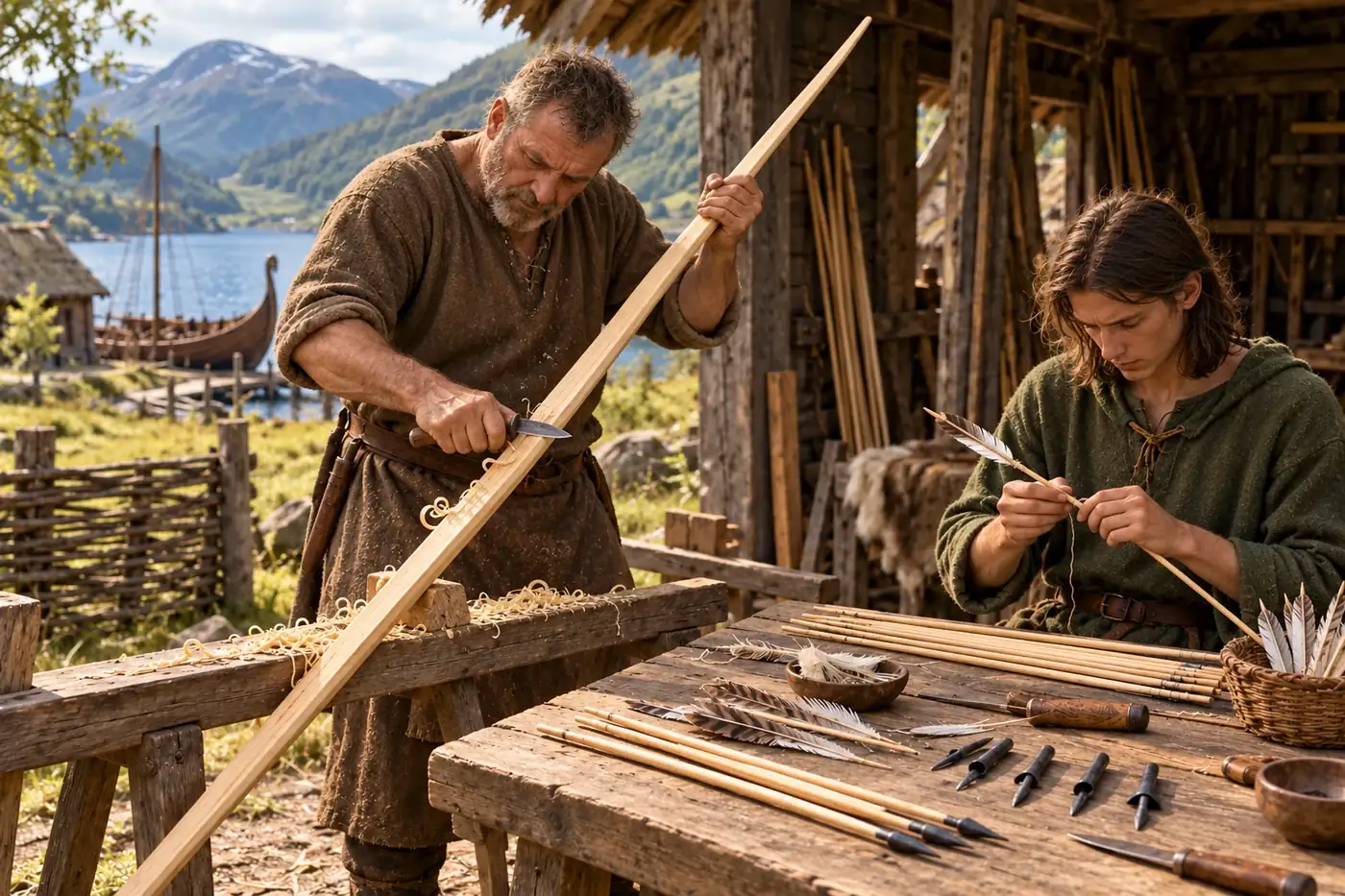
At Haithabu, museum craftsperson Reinhard Erichsen has made many wooden bows and arrows while exploring the historical craft. His background in woodworking gives the demonstration a material immediacy: visitors encounter hands, tools and timber rather than an object behind glass alone. The museum's interview makes this a useful example of living interpretation. [9]
That experience can sharpen the questions we bring back to archaeological finds. Which details correspond to a documented object? Which are the maker's solutions to missing information? On this page, the workshop scene and object still life serve the same explanatory purpose. They show an imagined arrangement of materials and finished forms. Their value lies in helping us notice the craft; the cited finds remain the basis for the historical claims.
Follow the evidence
Sources & further reading
Museum records, archaeological fieldwork and published research support the distinctions above. Date and context accompany each comparison.
- Pilø and colleagues: the Langfonne investigationPeer-reviewed study, The Holocene 31(3), 2021; dates, materials and site formation.
- Secrets of the Ice: Prehistoric Arrow Bonanza at LangfonneResearch-team account, 2020; collection chronology and the c. AD 700 arrow.
- Secrets of the Ice: the 2007–2009 investigationsLauvhøe feathers, birch bark and objects of differing dates.
- Secrets of the Ice: the 2013 discoveriesTrollsteinhøe arrows with organic remains, dated AD 300–600.
- Secrets of the Ice: Glaciers, ice patches and archaeologyPreservation, displacement and unequal survival of materials.
- Secrets of the Ice: Dating of Artefacts from the IceDating methods and the old-wood problem.
- Secrets of the Ice: finds before the programmeMuseum records from Lendbreen, Storhøi and other early discoveries.
- Viking Ship Museum: Viking bows and arrowsHistorical introduction on page 1; later modern activity pages are not archaeological evidence.
- Wikinger Museum Haithabu: Der Meister der LangbögenMuseum interview with craft demonstrator Reinhard Erichsen; modern interpretation.
- Museum Nord: The Norse bow and arrowUsed for the distinction between self bows and composite construction.
Continue the exploration