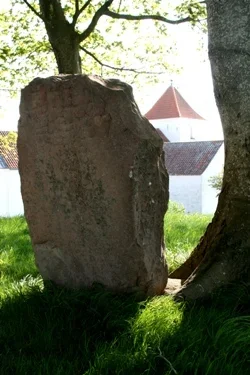
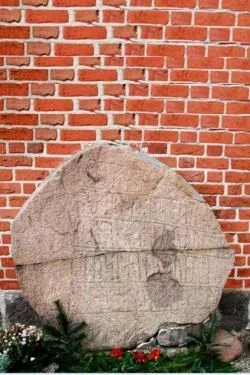
Explore well-documented stones and the people remembered on them. Choose a map marker or a photograph to read the story.
This is a curated selection of runestones, inscribed stone crosses and related rock inscriptions, including monuments from before and after the Viking Age. Anglo-Saxon and Norse traditions are identified separately. Each page distinguishes a readable summary of the inscription from a literal translation.
Country includes entries with a recorded country but no coordinates. Region filters use the displayed map reference point, which may be historical; they do not verify present-day display or visitor access.
Search and filters cover the complete register. Object types follow the existing entry descriptions; missing or uncertain types remain unspecified.
Showing 61–80 monuments · Page 4
Loading the map. Stone pages and documented locations are also available below.
Zoom in to separate nearby stones. Numbered markers group nearby locations. Only entries with documented coordinates have map pins. A pin may mark an earlier recorded position, an original setting or a later display location. Open the entry for the coordinate source and any verified visitor location. Browse the entries ↓
The inscription says a king named Olav shot between these stones. It does not identify which King Olav or explain the occasion. Stories linking the shot to the choice of a church site are interpretations, not additional information actually supplied by the brief inscription.
Roar raised the stone in memory of his father Olve. The short wording focuses on the relationship between the living commemorator and the dead man, without supplying a battle, journey or cause of death. Some portions of the carved surface are more worn than others.
The text names Thormund and addresses him with a wish that he benefit from the monument. Its unusual wording is shorter than the familiar formula naming both commissioner and deceased.
Asser commemorates Valtoke, called his lord. The inscription also speaks about the memorial itself enduring and continuing to proclaim Valtoke’s remembrance.
Eskil, Sulke’s son, commissioned his own memorial and asked Christ and Saint Michael to help his soul. A separate inscription records Toke carving for his stepmother Thora.
Tjodvi commemorates Odinkar. Alongside the memorial are the rune-row, a wish concerning the monument and an unusual sequence conventionally connected with thistle, mistletoe and a small chest; its purpose is debated.
Toke, Troels’s son, is named as the commissioner. The surviving text also refers to his brother, but damage prevents a secure account of all the names and relationships.
Tholv commemorates his brother Rade and praises him with the honourable term dreng. Here the word expresses esteem, rather than simply meaning a modern child.
Toste remembers his brother Tue, who worked as Asved’s smith and died in the east. The short text gives both a craft association and a direction of travel without naming a destination.
Only parts of the memorial remain. A name possibly read as Osbjørn, an uncertain family relationship and a reference to Harald survive; the whole sentence cannot be restored confidently.
Sasgerd, Finulv’s daughter, honours Odinkar, Osbjørn’s son, with praise for his status and loyalty to a lord. A hostile formula is directed at anyone who damages the memorial.
Thyra, Vigot’s wife, honours Thorbjørn, Sibba’s son, and describes a strong bond of affection. The kinship expression and comparison with a son admit different interpretations.
The heavily worn text is usually read as Asser, a land-manager and the son of a man whose name is uncertain, carving for Asbod or Asmod. Her title is conventionally rendered queen or lady. The reading is disputed and does not securely identify a known royal woman.
Østen’s sons commemorate their brother Spærle, identified as a shipman serving Esbern Næb. The text places family remembrance alongside a maritime association.
No monuments match. Try another name or reset the filters.
Reading the evidence
Missing or disputed words can change an inscription’s meaning. Our summaries explain the message without inventing missing passages. Names and dates may appear differently in other editions.
Photographs retain their individual licenses; credits appear beside every image. Where no photograph is available, the entry links to its documentary source. Location and historical sources are linked on each stone page.