

Research & Sources · Focused study
Two Cuerdale Ingots: Casting Marks, Nicks and Modern Measurements

In Brief
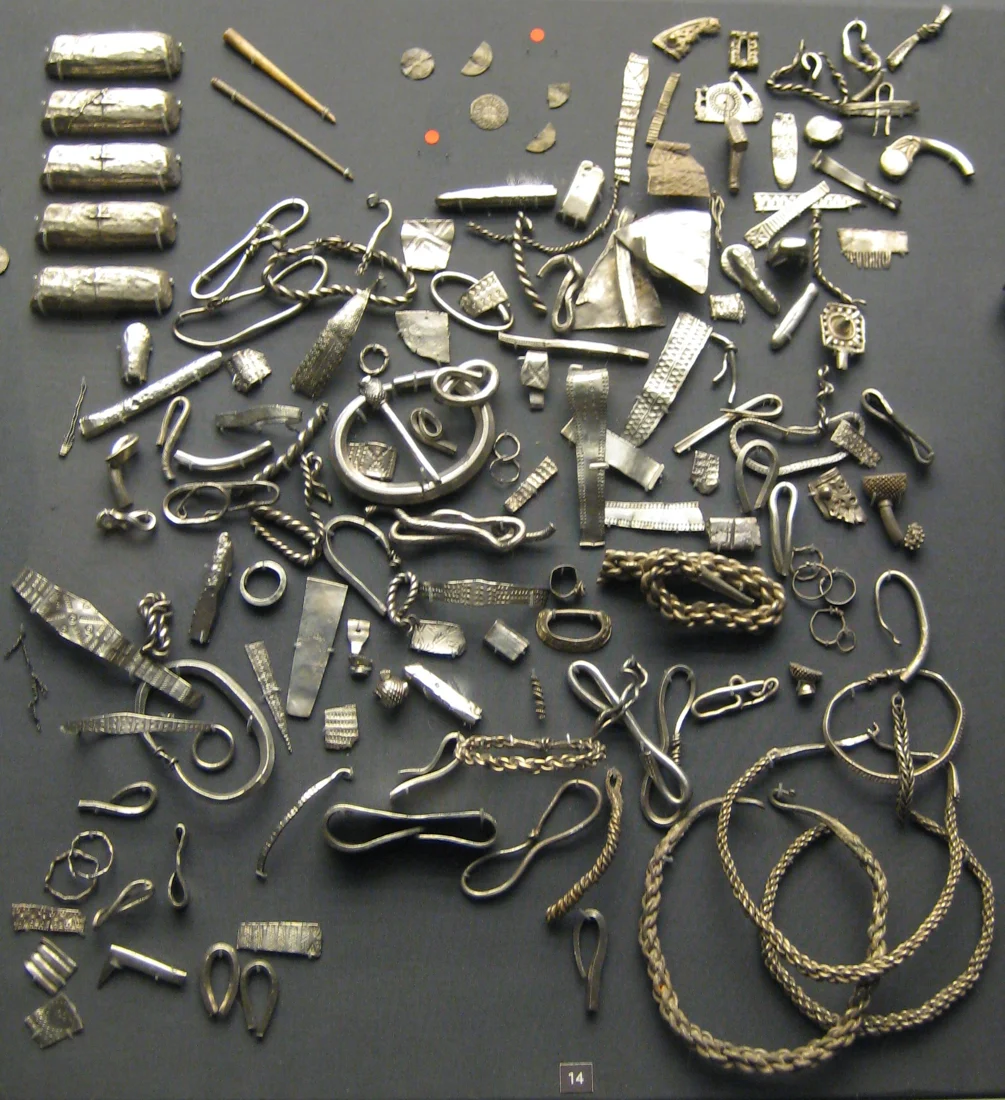
Two small pieces from the Cuerdale hoard show how much information a plain silver bar can retain. Their catalogues document shape, casting surfaces, cuts and even a modern intervention affecting a recorded weight.
On this page
A short ingot with a pitted surfaceA longer ingot with a qualified weightWhat a pair can and cannot establishSourcesA short ingot with a pitted surface
British Museum object 1841,0711.58 is only 29 millimeters long and weighs 12.02 grams. Its catalogue describes a rounded oblong form, a changing cross-section and a pitted mold surface, together with six nicks. These details move attention away from an idealized silver bar toward an individually made and handled piece. Casting did not produce a perfectly standardized shape. The surviving surface records a particular manufacturing outcome, while subsequent marks may represent a different stage of its history. Those stages should be described separately before their significance is interpreted.
Sources for this section: 1
A longer ingot with a qualified weight
Object 1841,0711.13 measures 62 millimeters and is recorded at 47.13 grams. Its description includes casting flaws, three nicks and a crucial qualification: the piece has been drilled. The present measurement therefore belongs to the object's current condition, not automatically to the quantity deposited in the hoard. That distinction is easy to lose when museum measurements are copied into a table without their notes. A precise number can be accurate as a modern observation while remaining unsuitable for an unqualified calculation of an original payment or weight standard.
Sources for this section: 2
What a pair can and cannot establish
The two records provide a small comparison of form, marks and condition within one deposit. They do not provide a statistically representative sample of Viking silver exchange. Their greatest value here is methodological: inspect each piece, retain qualifications and avoid turning damage into a narrative unsupported by context. One may compare their current masses or the number of documented nicks, but neither exercise identifies the hands through which they passed. Even visually plain bullion has an object biography. Careful cataloguing preserves the difference between what can be measured today and what one would like to know about its earlier circulation.
Sources for this section: 1, 2
The Evidence
The sources below support this article. Interpretations and limits are explained in the text; this is not an exhaustive research review.